
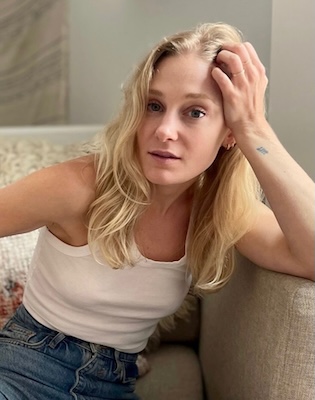
Nina Boutsikaris
fiction
Nina Boutsikaris is the author of the book I’m Trying to Tell You I’m Sorry: An Intimacy Triptych, winner of the 2021 Great Lakes College Association New Writers Award for Creative Nonfiction, and Small Press Distribution Bestseller. Her work has appeared in Fourth Genre, Assay: A Journal of Nonfiction Studies, Third Coast, Hobart, The Los Angeles Review, and elsewhere, and was listed among the Notable Essays in Best American Essays 2019 and Best American Essays 2016. Her short memoir “Surrender” was anthologized in the book, The Best of Brevity: Twenty Groundbreaking Years of Flash Nonfiction. Other awards and honors include The Kenyon Review Writer’s Workshop Peter Taylor Fellowship, Redivider’s Beacon Street Prize for Nonfiction, and Writer-in-Residence at Brush Creek Foundation for the Arts. She has taught at The University of Arizona, where she earned her MFA, Eugene Lang College, Catapult, and Gotham Writers Workshop. She lives in the Hudson Valley and is writing her first novel.
What People Do
I heard the bells for the first time after we had already purchased the house. It was our first house and we had been searching for nearly a year, during a period when the market was impossible and the entire valley was being bought up in cash. Four times, with four different houses, we'd been outbid after our offer had been accepted, which had been a difficult experience because each time we'd built up a story about our future in a place that we'd believed was now our home—what we would paint and plant, and how the holidays would feel, and which room would be ours, and which room could be for a child even, if we ever had a child someday—and then that future had been taken away, and each time I was struck by an emotional loss that was surprising and sharp, and that I was embarrassed by.
I cried after the fourth house and told my husband I did not want to look for houses anymore. A few months later, he found this one. He wasn't interested in giving up. He hated losing, for one thing, and for another he was determined to invest his money, most of which he had received from the recent and gruesome death of his father, into ownership.
I was afraid of getting attached again, so I remained cool and disinterested as we walked through the empty rooms of the house, once, twice, three times, shrugging throughout the process, not thinking too hard or looking too closely, steeling myself against disappointment. My husband made an offer, we waived the inspection, and soon we were casually handing the bank our savings and then the house was ours.
~
On a raised corner plot across the street from the house that was now our house sat a massive white church with two sets of red doors, two small and round and very wide-set windows, and a tall steeple high up in the sky. When we bought the house I did not know anything about the church, except that it was for sale and that it was the only church on a street named Church Street. I assumed that it was a century-old building, like so many of the buildings in the former mill village. But its shabbiness was newer, the result of the deterioration of more recent updates. Dirty aluminum siding, slats askew, some missing; brown cement steps split with moss and weeds, iron handrails rusted and oddly bent. A large triangle of stained glass had been removed from one of the red doors and replaced with plywood. Still, the disintegration was subtle enough that someone passing quickly might not have noticed how far things had fallen into disrepair.
The church had been out of use for some time before we arrived, but on the front lawn there still stood a large changeable-letter sign, still arranged to read All Are Welcome, to announce the times of weekly services that no longer happened, to publicize the name of a pastor who would never again appear on the pulpit. The church had been shared, apparently, between Methodist and Reformed congregations; the sign also reflected that, though it was unclear as to how this agreement worked. It was popular nowadays for houses of worship signs to be cheeky or punny, or to quote scripture, but this one did nothing like that. It contained only facts. Though of course, those facts no longer applied.
Closer to the sidewalk, much smaller and much closer to the ground, a realtor's flimsy For Sale sign had also been staked into the lawn. This was another kind of fact. A sale was pending on the church, according to our real estate agent, though she did not know who the buyer was. She was excited.
Things are really turning here! she said.
My husband and I had all these fantasies about what was going to happen to the church, and to the rambling, run-down parsonage beside it, which was also included in the sale. We loved talking about it. Who would buy a place like that? Another congregation? A restaurateur? A couple of artists? Maybe a local organization that had plans to create a community center for the village. That would be nice. We worried vaguely about cults, and about corporations in the habit of transforming historic buildings into short term rentals that no one would ever really inhabit.
Yes, long before we actually moved in, the future of the church became a topic that was inextricable from our own future. Whenever anyone asked us about our new house we brought up the church, and soon our speculative threads tightened into knots of likely outcomes. We began to lead with certain narratives, to believe the stories we'd once guessed at. It was definitely likely, we decided, that a music producer had bought the church to build a live-in recording studio (this had happened famously in at least one other church in one other former mill town in the valley), that the church would eventually be painted a dark tungsten hue and landscaped with tall, tidy grasses, and soon enough, instead of the silent trespasser smoking cigarettes on the church stoop in the mornings and leaving beer cans on the lawn overnight, there'd be a wealthy homeowner doing something similar in his place.
They'll probably paint it gray, I would say, or black.
And my husband would laugh and say something like, Would that be the worst thing? Would it be the worst thing for my property value to go up?
And other people would laugh too and say things like, Well whatever happens, it'll all just be part of everything else that is happening around here.
And we'd nod or frown and look at each other's shoes, performing a kind of ambiguous concern or concession about something that was not actually being expressed.
~
My husband and I had stayed in a repurposed church once, in a popular beach town one long weekend in late September, when the sun was still warm but rental prices had gone down. The church-house was small and historic, established in 1790 according to a bronze plaque displayed on its exterior. The inside had been simply and tastefully updated with gleaming wood floors and stainless-steel appliances, and the outside still looked just as it might have looked hundreds of years ago. From inside we watched tourists taking pictures of it as they walked past on their way to town. The owners had left a photo album on the marble kitchen island that documented the renovation, and we glanced through the images and were impressed. This was here, and that was this, we said, looking around at the spacious kitchen, the skylights, the little powder room beneath the stairs, and marveling at the difference.
The church-house was also haunted. Every night both my husband and I woke with a start a few hours after we had fallen asleep, tipsy and sunburnt and chilled from the wind, in the large four-poster bed beneath the church's cavernous eaves.
Why am I awake? I whispered aloud on the second night.
The room was pitch black. My eyes were wide open but there was nothing to see.
My husband put his arm around me, pulled the quilt higher up around our necks.
It's just the wind, he mumbled, or the wine.
But it wasn't those things.
Another thing about the church-house was the enormous brass bell that was nested in its tower. Anyone could see the bell from the outside. Inside, in the foyer, we could see that a rope was still attached to the bell, but the rope had been pulled high up, out of reach. A paper sign had been taped to the wall with a typed warning: DO NOT TRY TO REACH THE ROPE. DO NOT RING THE BELL.
We laughed at the sign.
Why leave the rope out at all? my husband asked. Why tempt fate?
The urge I felt to reach up and yank the rope with all of my weight was only made stronger by the sign. Like the dizzying desire that grabbed me when I looked over the edge of any precipice—compelled to leap, unable not to imagine the fall.
~
When we closed on our house we were still bound to our old lease, so for a couple of months we stayed at our old apartment, which was in a town not far from the new house. We moved our belongings over slowly, a truckload at a time. We had not yet spent more than one hour in the new house and I asked my husband if he didn't think that was strange. Like marrying someone you had not held or kissed or even had a conversation with. And my husband said it wasn't like that, that this is what people did, it's what his parents had done, and anyway we could always sell it or rent it and all that mattered was that we had something valuable now, we had something of our own, and we weren't wasting his father's money anymore.
Then it was spring, and our old lease was up, and one day we arrived at the new house with our bed and the last of our boxes and we could not return to our apartment again.
That afternoon we were in the backyard digging holes for hydrangea bushes while it rained, softly, on and off, and our overalls and hats soaked slowly through. It was warm and the rain was refreshing. It must have been a Saturday. My brother had brought the plants, and his husband was there too, to help, because they were both more experienced gardeners than us. They had also brought tools, a pickaxe and two shovels, and we were all hammering at the earth along the fence that separated our new yard from the neighboring driveway. My husband and I had never had our own yard before. The two dogs were sniffing and circling while we worked, dragging their nylon leashes through the freshly exposed dirt as it turned to mud.
And then, through the patter of rain, the bells began.
The sound was not real bells, but an electronic recording meant to mimic bells—syrupy and slightly swallowed, like a damaged cassette tape. The sound did seem to have a destination; there was a melody, but I did not recognize it. Or it was too many recognizable melodies, synthesized into one uncanny, generic loop.
The four of us stopped digging and looked at each other and laughed because the tolling was so present and demanding. It was right on top of us. And it was not as if it were beautiful.
Yikes, said my brother, Happy Easter?
Is it a holiday? I asked.
When we were children, my mother might have baked a lemon cake or surprised us with jellybeans and chocolate eggs. Easter was a harbinger of spring for us. Sweet, welcome. Nothing more. Still, I knew that that we understood, even as children—or especially as children—that there were things some people did, other people, foreign ceremonies shrouded in a formality, that felt sinister and also sublime. And that at the center of the ceremonies there was a ghost story, which many people believed to be true. Not only true, but essential to life.
My brother shrugged.
I looked at my husband, but he had already gone back to doing something in the dirt.
~
After a while the bells were still tolling. They were going on for far too long. The rain was coming down harder now, and all of this made it difficult to concentrate on the work or even to talk to one another. I looked up again to find that the day had become tinged with uncanny derangement. Something was happening. A joke at our expense. I felt faint and woozy. I had the sensation that each of us—my family, the dogs—was sliding slowly backwards in six different directions, like pieces of scenery disappearing into the wings. Come back, I thought. Don't leave me. My heart hammered firmly in my chest, up into my throat, and my mind began to chatter. It was possible, my mind was saying, that the bells might never stop. No one had warned us, and now we were stuck living at the mercy of these grotesque sounds. It was possible that we had made a terrible mistake, buying the house, committing to something we knew nothing about. It was possible that I had made many terrible mistakes, that I did not know who or where I was, where I had come from, or how I had gotten here. It was possible that I knew nothing at all for certain. Anything was possible, and yet this was the life I had come up with.
I took off my work gloves and went into the house and splashed my face with cool water. Under the sink I found my husband's bottle of pills left over from when his father was dying in hospice. I took a tiny bite off one of the pills, and then I went into the kitchen and made sandwiches. At some point the bells stopped and I began to breathe normally again.
~
We slept in the house for the first time that night. In bed I kept trying to describe the sound of the bells to my husband. It felt important to find the precise words.
It was the sound of something made of plastic, I said. A faded, pastel-colored toy left out in the elements, forgotten.
It was the sound of junk, of a past that was not old enough to be revered.
It was a sound that was underwater.
You'll get used to it, he said.
He rested his hand on my belly and smiled. It was still a soft belly. It was still a secret. We had not told anyone yet.
Eventually I fell asleep and nothing woke me except for the dog whining to be let up on the bed.
~
The next day my husband had to leave town for work. He left early and took the car so I was stranded at home, which was not quite home yet. The new house and I were not yet well acquainted. The rooms were unsettled with clutter and they also felt bare. There were so many boxes to unpack, there was furniture to shop for, art to hang; decisions to be made about where and how to store all sorts of things, like vitamins and spices and Tupperware. Fresh caulk in the bathroom, yellow wallpaper in the little bedroom to remove, a new color chosen, the room repainted. Whatever rugs we had were still rolled up because they were too small to cover the new floors, and we had not even begun to think about window treatments. I felt weak and nauseous, as though I had not yet fully recovered from a dizzy spell.
I made peppermint tea and stood among the chaos.
Hello, I said to the new house.
The house was silent.
~
Whenever my husband went away, I thought a lot about death. Or I was more aware of thinking about it. Fear nudged me from room to room, task to task, like an anxious breeze. It was different when I traveled without my husband—visiting friends or staying in a hotel alone for work, for instance. I did not fear death then, not in such an explicit way. It was something to do with being left alone in our regular life that made it feel as though we had both disappeared.
I took the dog for a walk. There was nowhere to walk to really, no places, like coffee shops or wine stores or busy parks. There was nowhere to let the dog run loose. So we went in circles, around the block, past the gas station and the post office, up to the top of the hill, looping around the old knitting-mill reservoir, which was smooth and still like glass. The dog nosed among the reeds that grew along the shoreline. We stood on the bridge over the roaring falls and I looked at the empty brick facade of the mill, its gaping window sockets, its ghost signs. The remains of the mill were beautiful. This was also for sale, according to our real estate agent.
It has so much potential, she had said. Lofts or studios is what I heard, she said.
You got here just in time, she told us.
I smiled at someone on their front porch who looked up from their phone when I passed. A woman being pulled by a large dog waved and crossed the street away from me. The crickets were very loud, though I did not see any. It was the kind of quiet that made me feel like I was being watched.
We walked for a long time. On the way home I heard the bells for the second time. It could have been noon, it must have been some hour, though I did not think to check. What was the song? I tried to pick it out, but it made no sense. I was still a few blocks away from my house. At a distance, the sound was not as ugly or artificial. It almost sounded real. A burst of tenderness rushed up into my throat and it ached and my throat was like a dam.
~
I tried to unpack what I could on my own. I organized the pots and pans and hung up most of my summer clothes in the bedroom closet. Night fell and I was ticklish and buzzy from the inside out, as though my body was filled with one hundred flitting moths. My husband texted.
Are you sure you're ok? he wrote. Are you feeling ok? Let me know you're ok.
I texted him back that I was, and he did not answer. He was on an important work trip and would likely be at dinner for hours.
Alone among our collected things, death felt near and easy, the tap of a wand on the shoulder. Being alive now, being alive still, felt improbable. More of it—tomorrow and the months and years it would take to do anything or be anyone, to make decisions, to nurture relationships, to learn a new language, to be old with my husband, to become myself finally, while also being this new, other self—felt even more improbable. That there could ever be enough time was impossible.
I found a box of pasta and a jar of spaghetti sauce that we had brought from the apartment. I watched an episode of a show I had already seen on my laptop and ate too much of the pasta and then got into bed.
I called out to the dog but she did not come. Normally I could not get her off of me, not when my husband was home. I called again and again, and when I went looking for her, I found her downstairs in the dark, the brown smudge of her body belly up on the sofa, butterflied legs, front paws sticking straight up like two fluffy batons. When we got the dog, she had been a puppy. I'd never had a dog before. She was soft and very small and good-natured. She slept when we slept. She rested when we were quiet and still. I often thought about the things my husband and I might do if we did not have the puppy, the things we used to do in the old days. Overnights in hotels, spontaneous day trips, long hikes far away.
Oh, but the puppy . . . we thought now.
There were so many places she was not allowed to go, she was still too small and vulnerable for strenuous hikes, and we did not want to leave her alone in our apartment for too long. All those things, the museums, the hotels, the other places, were so far away. Besides, at the time it was unsafe for anyone to go anywhere. Anytime you went anywhere you had to justify why, and I didn't want to worry about that.
It's not that we went absolutely nowhere. We took her to the fenced-in park and wore masks and stood far apart from the other people and laughed and chatted about the animals who were playing at our feet. We walked her to the store down the street from our apartment and bought coffee and wine and sometimes chocolate chip cookies. The puppy was overwhelmed by other people. She loved them so much she could not control herself and she would bark and jump. This made it difficult to take her on walks on the main street, so we kept to the residential streets where we were less likely to pass anyone. It was a quiet time and it was mostly just the three of us.
Do you think she's bored? I asked my husband.
No way! he said. Her life is so good.
~
I picked up the dog and carried her back to bed, where she stayed for a few minutes before leaving again. Her tiny nails click, clicking down the stairs. Furtive, I imagined. Awful, I thought—and I watched in disgust as I turned needy and bitter against her, so quickly. I worried that this was the kind of mother I would become. I had wanted to make important things in my life and I kept thinking that someday I finally would. Time was running out. I felt this acutely, like the tip of a dull blade pressed to my chest. I was the one who had to be the mother, after all. I was the one now, who might end up cruel or bitter or lost or abandoned. There were so many ways to abandon a mother.
Please, I whispered.
I closed my eyes.
There was no answer.
After a few minutes I got up and took another tiny bite of one of my husband's pills and then went downstairs to where the dog was. My laptop was on the coffee table, along with several small cardboard boxes containing partially burned candles and a collection of beach shells and other unpacked knick-knacks from the old apartment. I opened the laptop and searched around online until I found a link to the village historian's website and then a page about the history of the church. I looked, but I could not find any information about the bells. Instead, I learned about a 1938 flood and a time capsule. The flood had washed out half the village. But not the church. The congregation had buried the time capsule in 1972, the centennial year. The historian did not say where the time capsule had been buried or what it contained.
There were no blinds or curtains on our windows and from the sofa inside my dark house I could see the abandoned church, partially lit by an orange streetlamp.
Now the dog was standing by the front door, staring at me. I was frightened to go out. It was dark out there, and silent.
I felt angry at my husband for leaving me alone at a time like this. If the smoking man was on the church stoop, I would not be able to see him hidden in the shadows of the trees. There were a few lights on inside the windows of nearby houses, but this did not exactly bring comfort. I did not know any of the neighbors yet.
The dog whined and wagged her tail. I pulled the blanket from the sofa around my shoulders, found the leash, and unlocked and opened the door.
For a few minutes, perhaps, I stood on the porch while the dog sniffed in the grass. It was a cloudy night, cool and misty, and the wide lane of asphalt that separated my house from the church was spotted with damp patches. It was still. No wind. I tried to see into the darkness beyond the light cast by the streetlamp. I looked closely for the red glow of a lit cigarette. I listened for footsteps or rustling, I listened for danger. But heard only crickets. The dog pulled, and then I was on the bottom step.
It was late.
How much time had passed?
I yawned, but only my mind felt tired. The dog jerked this way and that and my palm cramped as I caught the rope. I wondered how many time capsules there were in the world. Perhaps there were thousands of boxes of mundane objects intentionally tucked beneath the dirt. The dog pulled again and now I let her lead me through the grass. I was not wearing shoes and the ground was very cold and wet, and I inhaled sharply. We moved towards the sidewalk, we crossed the wide, blank street, and then we were at the foot of the church yard. I wondered if anyone could see me from inside their house, if I appeared strange or frightening, huddled in a blanket on the otherwise empty street. I moved into the shadow of the oak tree. I thought about how brave my husband was, and how good; how he had slept in the hospice beside his father whose skin had gone gray and who could not speak. My husband had pressed his nose to his father's hairline and breathed in his smell until the man was gone, and maybe even after that.
Now the dog wanted to go home, she was frozen in place and would not let me lead her further away from the house. But we were at the church steps now, and we had come so far. I was not ready. I looked up, up, up, up to see the outline of the steeple, the bell tower that did not really hold a bell. I wondered what it looked like inside. A jumble of wires and speakers. Or maybe inside there was nothing at all. I wondered when I would hear the bells again, and what they would sound like to me then, in that future time; and then what they would sound like in the future after that. I wondered who paid the electricity bill and how long that would last. Not long, I imagined. Not at this rate.
I looked back at my house across the street, with its fresh coat of paint, and the house looked very big and square, like a big box. A box filled with boxes. And somehow the box was already in the past.
I picked the dog up and she was kind and let me hold her without wriggling away. I squeezed her soft body against my belly, my chest, felt the thinness of her skin sliding back and forth over tiny bones, so close beneath the surface. I knew that what I had to do was to pay attention, and that eventually a pattern would arise, and then nothing about the bells would be unpredictable or frightening, and everything would make sense. Soon the sound would become a comfort, crystallized with meaning. Then it would fade into the background, and sometimes I would forget to hear it at all. Later that autumn we would learn that the pending sale on the church had fallen through. In time there would be more speculation, more pending sales. I waited for years, but nothing happened, no one came.
“ This story scares me a little, and I've never written a story that scares me before. Not since I was a kid, I don't think. So I'm pleased about that. As a marker of I don't know what exactly. Something good, I hope. ”