
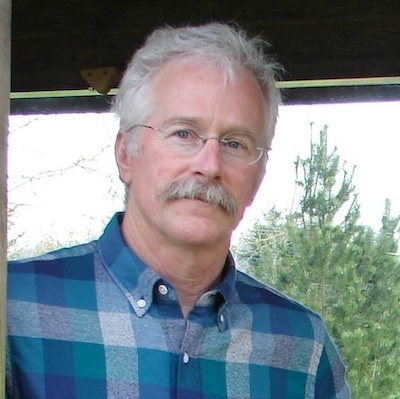
Patrick Vala-Haynes
fiction
Patrick Vala-Haynes writes fiction, poetry, and essays within shouting distance of the Oregon Coast Range. He knows too much about well-drilling, swords, cannons, and alfalfa. His writing has appeared in The Brussels Review, Dulcet Literary Magazine, Sand, Slate and elsewhere. He is a Sundance Screenwriting Fellow and recipient of the Emerging Writers Fiction Award at the Montana Book Festival. As a freelance Fight Director, he has choreographed sword fights and hand-to-hand combat for more than a hundred stage productions. You can find him online at patrickvalahaynes.com.
The Dancer
I went to class this morning. Madame Artois thanked me for being on time and I wanted to tell her to kiss my sweet ass. It’s the radiators in my apartment. They don’t know when to quit. And the voices. Some nights I’ll listen at the window that opens onto the park, to the winos telling their stories and slapping each other on the back. All that playacting. Bouncing from needless sorrow to barroom cheer. I sleep mostly between three and six and sweat the rest of the time.
But first things first: this morning.
Breakfast! Even for November, there was too much light in the room. I dumped my coffee in my lap and lost an orange to a bad bounce—out of the basket and off my fingertips, one ripe thud on the sill and a three story drop to the street. Well, it’s the anticipation I survive on anyway. Morning sucks. I rinsed out yesterday’s tights, along with my pajamas, and hung them above the sink. I toyed with the idea of doing the dishes, looked at the clock, and decided to surprise Madame Artois instead. She can be a perfect little bitch sometimes.
“Eileen, remove your sunglasses.”
I dance. I don’t cook, I don’t keep house, I don’t have any plants and I hate doing laundry. That’s what’s great about living in tights and leotards: a quick dip in the sink and I’m done. My home might be a mess—I’m a slob, I admit it—but I can always close my eyes. I could even clean up if I wanted to, but who would appreciate it? I don’t let things rot.
I don’t let little pains bother me. Like hunger pains. An orange can usually get me to lunch. You have to eat light for ballet. No orange is too light. I’d love sausage for breakfast, but not before ballet. The dancer who works next to me is a vegetarian and says I sweat the stuff. I tried bacon and she turned up her nose at that too. I don’t need that kind of grief; dance is precious enough. I’m not giving up meat.
I like meat. I have a hamburger and milkshake for lunch. Always. After ballet is jazz with Lucy. Meat is good for jazz. The milkshake is my concession to osteoporosis. You’ve got to take care of what you have, Grandma says. My bones, I think she means. She likes my bones.
I’m not a sapling. I’m not a delicate whisp of a girl. No breeze is going to blow me away. Madame Artois is disappointed, of course, and would like to blame my body on my milkshakes, but she’s a grandmother too and must have a granddaughter somewhere with big bones and muscles because all she can really do after shaking her head is go “tch tch tch,” which makes her uppers want to fall out. Then she gets mad at me and helps me with my stretching routine.
I don’t worry about the things poets—or dancers—worry about. I don’t worry about the sound of things and I certainly don’t worry about ice cream. No one messes with my ice cream. I need to eat. I do more of the heavy lifting than the men at the studio. Madame Artois appreciates who I am. She brought a five-gallon bucket of vanilla ice cream and twelve spoons to one of our rehearsals once, then turned off the lights so none of the flyweights would feel guilty. The thought counts.
Dancers take care of their bodies. Most of the dancers I work with do, the ones who stay with Madame Artois. Other than the young ones, who come and go. She accepts our bodies, even as she scolds. There’s an erotic flavor to the studio that underlies the stressed muscles, the twisted groans. For me, every step is a sweet stroke, a hand on my body. Even when I’m drenched in sweat and fighting a grimace, I never think of giving up the hot press of muscle and will. Ice helps. A long bath helps, though I know age is not arbitrary, that numbers can have meaning. That time is coming. Even forever after gets a period.
The counterpoint Madame Artois offers has always gotten my attention. She thinks my bones should be able to bend. After work with Alvin Ailey in the 50s, her career turned on a knee injury that refused to heal. She didn’t slow or slink away, but took what she knew and began training men for the ballet before opening her studio. She got me. Sometimes she smiles at me.
“Those muscles! What can we do with those muscles?”
I know what she can do. She can make them hurt. She can make them do little dances all by themselves. I’ve been with Madame Artois since I was fifteen. She says she can tell when I’ve had only coffee for breakfast because my eyes wander during class, and since she’s convinced I can’t see anything before eleven o’clock anyway, there’s no other explanation. She can be very sympathetic. A real sweetheart. This morning there was powdered sugar all over her lips. I try not to be cruel, but took special pleasure in that. She must be seventy years old, and I shouldn’t make fun of her. No, I know her age, but I’d have to do some subtraction to figure it out. Seventy is close enough. She’s Quechua, from the Sacred Valley of the Incas. Mongrel, she calls herself. I assume that’s where “Artois” comes in. Her cheekbones are like glass. Red glass. You can see the blood in them. That’s what I like about her: I can’t imagine her ever being cold to the touch. And she moves with such precision. Her whole world is one of symmetry and balance. There’s nothing false or stiff in her manner. No affectation. She isn’t a worn-out roadshow. She loves what she does. I’ll never leave her, even if symmetry and balance make me want to puke sometimes, which a couple of the other girls do as part of their morning routine before class. You’d think they were doing their lipstick the way they smile and smack their lips after.
They’re not going to last.
I’m not nearsighted. I have family to keep me around, but there’s no one special. No candlelight dinners, no bouquets. I’m not afraid to leave this city. Every time I see my mother she asks me why I’m not in New York. What would I do in New York? Dance, she says. No, I wouldn’t dance in New York. I’d wait tables in a diner and scramble to get a part in the chorus line of a new musical. That’s not dancing, not for me. There are so many new musicals I could not dance well into my thirties. Here I dance. I choreograph. I perform. An audience of twenty is all I need. I’m not afraid of fame, but I’m not looking to have a star over my door. I don’t need to be discovered.
I told her no way, about New York. Then she tried to convince me to come to Seattle. Like I could live that close to her. She says there are more opportunities for a dancer there. I told her I didn’t dance for the money and she said, “Well, of course you don’t dance for the money, Eily. You’re an artist. You dance because you don’t want to bother with a shrink.”
~
I’m almost twenty-three years old. I know there are a lot of people older than me, but I’ve been on my own since I was sixteen. I’m not a castaway. I haven’t had to beg for a living. My parents set up a trust fund for me—nothing extravagant. It pays the rent. Privileged, I know. I work in a fish market three afternoons a week to cover groceries. I’m on scholarship at the studio, which means I rig lights for our performances, push the piano around, and spread posters throughout the city. I painted the ceiling two years ago. I smile at Madame Artois. Tights and leotards would be a problem—financially speaking—but my father has a passionate love affair with anything slippery. He knows all the best shops, and he doesn’t mind if I throw in a pair of boots or a pretty blouse. And dance shoes, we buy a lot of those. I like jewelry too. Gold. Silver. Opals. I’m not a spoiled brat. Most parents would be paying for a child my age to go to college, maybe graduate school, not to mention the psychological havoc a daughter can wreak on a family. I’m a bargain. Really. Still, my parents should have been sterilized. After me, I mean, which wouldn’t have mattered because they didn’t have any other kids, and I’m all right, but in my dark moments I think I should have been born to someone else. I love my parents, but I call them by their first names.
Was I the byproduct of a doomed love? Hardly. Their love was more than likely not love at all, but I was no byproduct. Both Leo and Victoria assured me of that. There was a marriage, though I don’t know why. Their coupling, purposely risky for a woman relying on the rhythm method, was fully conscious. And joyous, my mother stressed. Spasms rule, no matter what time of the month. Leo got something he wanted. Victoria got something. That she was the one who chose to disappear for most of my upbringing was neither to be regretted nor celebrated. It just happened. Victoria shrugged when she told me that.
My mother lives in Seattle. Leo doesn’t. I can honestly say I had nothing to do with their split-up, or whatever it was, so I don’t carry any more guilt than the average confused child. Even if they were together, which was never in the script, I doubt I would want to live with them. Even if I were sixteen again. They’re not particularly nice people, not when they’re in the same room. I mean, they don’t shoot people or anything, but they can hardly have coffee together without pyrotechnics. They’ve emptied more than one café. I’ve looked at my birth certificate, I know my roots, I’m only being honest. It would be easy to create a fantasy. I don’t like being alone all that much, but I’ve gotten used to it. I’m not sure I want to have someone I need to please, someone who is always there.
Victoria is an actor. She’s quite good, a regional success, she says. Any particular region? I asked her once, and got slapped. I was just being cute. No, I was being a bitch, but she picked a hell of a time to treat me like a daughter. She wouldn’t have slapped a friend, and that’s what she wants me to be. I try. I used to think she was paper-thin because, well, because makeup adds ten pounds. The stage puts all those eyes on you, like I need to be reminded. I don’t see her very often. I go to her openings and she comes to mine. She makes her living in the theatre, which is exceptional in the Northwest. She also teaches. The Northwest isn’t very forgiving of artists. She hustles her ass all day long and still finds something left over to give in the evening. I couldn’t do that. Or, I do that, but I don’t brag about it.
My mother competes even when she’s asleep. Her dreams are better—just better. Sunrise to sunset. Put her in a crosswalk, she wins. A sidewalk café? A spinach soufflé? No contest. She carries herself just so and never misses the opportunity to throw an exclamation point into her speech. She’s especially fond of cocking her head. All her physical accents are sharp and crisp, like fresh lettuce. She’s a marvel. She’s very thin, bony even, but with a nice pouchy ass, and a little taller than I am. Really, she doesn’t speak like a normal person. She sings, she rants, she drones, she runs the scales and beats the drums. Words ripple up and down the ladder along rhythmic waves so prettily you can hardly feel the knife twist. I miss her right now. I miss her voice. She knows how to fill the white space that surrounds me.
Victoria is not every-mom. When she comes to my studio performances, she applauds and shouts like she’s in a stadium. She brought me a dozen roses once, which was complete overkill. After small talk with Madame Artois over pastries and tea, she rushes back to Seattle in the middle of the night. She hates waking up in strange beds. If I’m in Seattle to see one of her shows, I always spend the night. I don’t mind strange beds. However, she’s a morning person, and she’s so pretty, so clean and alert, like a bunny in a garden, that my eyes positively revolt at having to look at her. Perfect hair, perfect eyeliner, never molting. She drives me fucking crazy! Me, I like to hang out in the morning. I don’t want someone picking the sleep out of my eyes.
Flit, flit. Leave me alone. Shoo! Shoo!
I was young enough when Victoria and Leo separated that I never thought of myself as having parents. Parents as partners, I mean. I had one here and one there. Weather changes. Bi-polar has much to recommend it. Leo told Victoria that a daughter needed a mother, and Victoria agreed. She said, “Okay, you do it.” I know I ended up with the best parent.
~
My father is a big man. He’s tall and wide and has skin like the bark of an oak tree. When he walks, he makes noise. Clicks his tongue or scuffs a shoe. Snorts. I think he does it on purpose so people won’t think he’s trying to sneak up on them. He wants to be kind, even if he overshadows everyone who gets near him. He seems to always have the sun at his back, unless he’s on stage. Or that time he did the poetry reading at the Agora Café when he asked to be side-lit. Something about raising his left eyebrow for punctuation, otherwise the poem didn’t work. Try getting anywhere with him at the wrong time of day! Poets can be such superior beings. But fathers, well, fathers are known to have faults. Leo would rather be a poet.
Poets are romantics. They live by candlelight. The click of a light switch can send them into a rage. They’d rather bump into things. Leo is always nursing wounds. Little bruises. I’ve told him he needs to eat more fruit.
“But darling, I’ve given up on all those flowery imitations. The bouquet, well, I miss the bouquet, but what I want ...”
Sometimes I think we’re destined to give each other heartburn.
But I like my father. He’s the most interesting man I know. That says something about American men that a girl thinks her father is the best catch around. Allow me to amend that: a model for the best catch. We’re a sick family, but not that sick. Oh, he’s crazy, and I don’t mean he jumps through flaming hoops or dances on tables and can stuff a whole orange, peel and all, in his mouth. Big deal. I can do all those things, plus I can suck a cork out of a wine bottle and spit marbles with enough velocity to give someone a black eye. That’s what I tell people. A girl needs useful skills. Leo, however, is talented beyond measure. When he treads onto the stage in his silk booties, you’d think he rode in on a Harley. He roars. He spits smoke. He sings off-tune but still gets the ovation. Maybe someday he’ll squeeze me into a chapbook.
No one wants to be in someone else’s orbit all the time. If he weren’t who he is, I wouldn’t be saying these things. Even without effort, he can be a cryptic son of a bitch. Some days, only his poetry makes sense. Which is scary. Poets and their words. I’m not bitter, knowing he’s disintegrating. Age, disease, lack of faith, loneliness. Why does he get to choose? I could be a little sad, but sadness doesn’t become me, not at all. It’s not that tears ruin my makeup: I don’t like to cry. I’m not my father. Tears piss me off.
I don’t worry my life is boring. There’s a sameness to each day, I know. I go to dance class. I come home. I sleep. I don’t go to church anymore, but I’m not a little heathen. I have my rituals. I keep holy the Sabbath. Sunday has always been special to me. I get up early and walk to the newsstand on Yamhill Street. I pick up a copy of the Seattle Times, since the others come by mail a few days late. I read The Oregonian daily, but I like the Seattle paper on Sundays. I run home, spread Seattle on my lap, and try not to spill coffee on her.
I see Leo the first Saturday of every month. He comes to my morning class, teases Madame Artois—I don’t know what he says, but she grins and slaps her butt as she sticks her nose right in his teeth, and they come to a truce. Then he takes me out for ice cream. Sometimes we shop. Sometimes we walk the city, drink coffee, pretend we’re a normal father and daughter and he’s not the Polar Star. Sometimes Leo gets badgered for an autograph or someone wants to show him some poems. I might as well not be there. He comes to all my dance concerts. Studio performances are all they really are, but Leo calls them concerts. Closings only. He loves saying good-bye, especially lately, so I get to see him a couple times each month. About as often as I see the grocer. No, that sounds bitter, and aren’t I trying to avoid that? I see him almost as often as I want to.
He lives with a man now. Another poet. I know he’s a poet because I’ve seen him on stage and read everything he’s written. Daddy—when I was little I called him that, and now when I’m pissed off—wants to whore me out to him. That’s not quite how he put it. I can be dramatic too, but I’m no fucking muse. I’ve seen him perform, this other poet. He’s no Robin Morgan, but he’s not useless. I hear his voice when I read him. I see his mouth letting go of the words. This one’s different, not because he's pretty and sweet. There have been lots of poets, but this one must be different because Leo hasn’t gotten him into his bed. He says he doesn’t need to. I could say I don’t understand, and that would say a lot about how I feel about Leo, but I’ve never seen him so in love. Isn’t that odd? Love is the stuff of hope, and I think my father has lost that.
I don’t think of myself as a romantic. I’m pretty tough. I don’t believe in chance. I mean, I think anything can happen at any time—I read Sartre’s Nausea, even if I didn’t enjoy it—but I’m not a romantic. I’m not a victim. I dance. There’s nothing of coincidence in dance. I feel what I’ve been given to feel. Sure, my body tempers the dance, but mostly I interpret. I struggle to create. That’s where Leo and I begin to fight. I don’t think art and interpretation are the same thing, and he does. Personally, I’d rather fight about how much salt to put on the popcorn.
Leo has an old man’s body. I don’t mean he’s falling apart or even that he’s old, but there’s a heaviness to him. He’s not so fat or anything, but his body is solemn. He drones like a church organ. He agonizes about having a flat butt—thank God I got some of my mother’s genes. Even though he is my father, even if his blue jeans do hang halfway to his knees, he’s so much like other men. Men’s bodies are so serious. I think a man invented the notion of gravity. Sure, gravity was always there, but it took a man to sanctify it.
I think about what men want from a woman. What they want from a man like my father.
That’s not a problem, thinking. I’m not some puffed-up Cinderella standing around with my party dress on. I’m not waiting for someone to knock on my door. I’m not waiting, period. I have my dance, I have my newspapers, and I have ice cream with Leo.
~
My mother rarely talks about Leo, unless to pout over his success. All those apples wanting to be plucked, she says. What does he do to deserve so much attention? She thinks poetry died with T.S. Eliot, or wishes it had. She’s pretty sure the Beats died with Kerouac, and she might be right. Now, eight years later, Leo’s candle has to be burning low, but not so low he can’t fight back. He puts theatre people on the same bench as academics.
“You’re always in character, Victoria,” he tells her. “Or tuning up. British accents, Southern accents, a flip of the wrist. A lisp? Oh, please! Whatever happened to just telling the damn story?”
“You have a lisp.”
“That’s because I’m a faggot. And, fuck you!”
They’re so much fun when they’re together. I’m glad I chose a silent art.
I see myself when I dance, as if I’m in the audience. Nothing quite so esoteric as leaving my body. I don’t float on the stage with the vague hope of occupying someone’s vision. I work. I own my space. Some dancers are completely internal. But I think if dance isn’t dialogue it’s nothing more than self-love. Think of the Dance of the Seven Veils, if you have to. The scrim I have to shed isn’t mine. There are already eyes on me. My job is to NOT give them a reason to blink. I tear their lids off. Metaphorically. I want them to see something. Like that scene in Kubrick’s A Clockwork Orange when Alex’s eyes are ratcheted open by metal braces and he's forced to watch the things he loves, forced to watch them go ugly. It’s not ugliness I’m going for, nothing so meaningful. I don’t find purpose in helping people confront a truth. I’m just reaching out, a beggar with a body. Who cares about the stage? A body in motion should be more than a third-person performance, a shape in the lights. It should be the beginning of a conversation.
I know I have a soft life. But I dance. There’s not a chance in hell I’ll ever make a penny at what I do. I shine when I’m on stage. That’s what I’m supposed to think. An especially kind review said I sparkle, but that was just sweat. I sweat like a trucker. That’s why I demand the right to wear sleeveless leotards, so my wet armpits don’t take over the performance. It’s not vanity—though I have great shoulders. Madame Artois gives me the most difficult moves. Who else among her dancers can launch a teenage waif five feet straight up and not muff the catch? Not the men. When I bitch about my pains, Madame Artois just raises her brow. Her nostrils flare when she raises her brow.
“Muscles. Think how you will feel when you are seventy.”
I’ll buy bigger bags of ice when I’m seventy. I’ll take longer baths. We both bitch. She can bitch all she wants, but she loves what I can do with my body.
When I get home in the evening—if I come home in the evening, if there’s not a rehearsal or studio performance—I take a bath. I do nothing before my bath except undress. I don’t eat. I don’t read the paper. I don’t turn on the lights; there’s usually enough buzz from the park lights to throw a few shadows into my apartment. I barely open the door.
After my bath I read one of my papers. With the lights on. I have salad and Coca-Cola for dinner. I don’t cook and I’m not looking for a man who does. So many of the men I know are dancers, and those who aren’t gay are constantly trying to prove they’re not. So they might as well be gay, as far as the chances of my having sex with them are concerned. They’re so clumsy, so desperate, showing off those little bulges between their legs. Don’t they know they look better from behind? At least then I can use my imagination. Men are too obvious. I don’t mind being desired, but wanting to stick your bauble in a hole is not the same as desire. Not really. Sometimes I wish I were attracted to women. Men have so many issues, but after spending most of my day with women—blah blah blah. Maybe I just want different issues to deal with.
I like reading all my papers. I get copies of the Sunday New York Times and the San Francisco Chronicle in the mail on Tuesday. They last me most of the week. It’s like having friends from other neighborhoods drop by. The conversation gets rolling and before I know it, I’m on a rant and it’s past my bedtime. I try to get to bed early. Not that I’m going to get up early, but as long as there are no rehearsals, I try to catch up on my sleep. It’s the damn radiators. And the winos. Even if I don’t sleep, my bed is my home. With two pillows under my head, I can see into the park. The stage doesn’t change, but I get a new movie every night. Ingmar Bergman. Sometimes Truffaut. Sergio Leone on Thursdays. Artists aren’t as mysterious as people say.
There’s a statue of a horse in the park. Some people say it’s a statue of Teddy Roosevelt, because he’s the one sitting in the saddle, the one with the roughrider gaze, as though he alone knows the special pleasures and responsibilities of being a man. But the horse is what matters. I think Teddy finally figured out what it felt like to have real power between his legs. Anyway, he doesn’t look nearly as good in bronze as the horse does. The old men who gather there in the evening to collect her heat—yes, Teddy is riding a mare—must agree, because they’re always polishing her muscles with their dirty hankies and spit. They snuff their cigarettes on Teddy’s boots. I watch from my bed as Teddy grows dim and the horse grows brighter in the park lights.
“ ‘The Dancer’ is adapted from my novel in progress, The Poet and the Dancer. I’ve never shied from inhabiting the voice of a woman. Indeed, writing fiction is my opportunity to explore new voices and imagine lives other than my own. There’s little metaphor in my work. Invention, yes. My characters are people who wonder what all the fuss is about. They don’t believe they’re worthy of a story. ”