
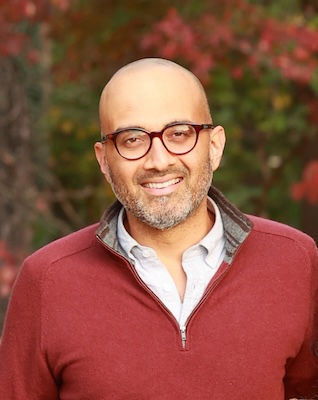
Akshay Pendyal
creative nonfiction
Akshay Pendyal is a physician and writer living in North Carolina. His prose has appeared in The Brooklyn Rail, Persuasion, and The Hedgehog Review. His poetry has appeared in the Annals of Internal Medicine and the Journal of the American Medical Association.
Of Medicine and Mexican Food
Growing up, it seemed like we went to a different National Park every summer. Reliably, a few weeks after school let out, my parents would begin to pack up our station wagon; over the years, we’d check them off the list one by one. Yellowstone, the Grand Canyon, Mount Rushmore—all places that, as new inhabitants of the capacious idea known as America, they knew they were supposed to have seen and documented with photographic proof.
Stops on the road were seldom and, as vegetarians, we ate what we always ate: rice, daal, dahi, and roti that my mother had dutifully packed in a stackable metal tiffin box the night before. At a shaded rest area, she would expertly unpackage the contents, doling out scoops of lentils onto Styrofoam plates. In the afternoons, after we had been driving for most of the day and the heat threatened to overwhelm our car’s A/C, my dad would pull into a gas station so that he and my mom could sip cups of tea poured from a Thermos.
We’d stay the night at distant relatives’ houses in Texas and Oklahoma, where dinner was served in the same floral-patterned Corning dishes that we used at home. And just like at home, Hindu iconography dotted the walls—a painting of blue-skinned Krishna holding a flute, a batik print of Ganesh and his unperturbed gaze. In the morning, we’d set off again, bhajans droning out of the tape deck.
~
Maybe my parents could sense the rays of adolescent angst emanating from the back seat. Or maybe they just knew that they didn’t have long with all of us under the same roof. Either way, it was during those long days in the car, when the sun was at its highest, the air shimmering above the Midwestern expanse, that my dad would turn to my brother and me and ask: “Taco Bell?”
Even my dad—Dad, who ran three miles a day, whose topspin remained unreturnable well into his fifties—couldn’t resist the alchemy of spices and seasoning contained within Taco Bell’s refried beans.
Much has been made of the affinity that Indian-Americans have for Taco Bell. I’m here to tell you that it’s all true. It’s easy to forget, now that meat substitutes have become nearly ubiquitous, but at one point in the not-so-distant past, fast food vegetarian offerings were limited to items on the margins of the menu board, in what felt like afterthoughts. I recall at least one instance in which we ate, as a family, a meal of French fries and rectangular apple pies in cardboard sleeves.
Except at Taco Bell. By simply uttering the magic phrase “sub bean for beef” (over the years, I’d even start to place my order using the Taco Bell cashier’s same keyboard syntax: -BF/+BN, “minus beef, plus bean”), you could gain access to nearly any item on the menu. A gooey, Cheesy Gordita Crunch, with its impossibly pillowy outer crust? No problem. A Chalupa Supreme, its molten contents ensconced in a flaky golden pancake? Why not make it two?
But the affinity runs deeper, beyond one of mere convenience or access to variety. In America, to be “from” somewhere else is not simply to have a name that, in the words of the critic Hanif Abdurraqib, doesn’t “fit comfortably in other people’s mouths.” It is to be in 1st grade and, when everyone else is eating hot dogs, be given a bun filled with only ketchup. At the risk of lapsing into Asian American Studies cliché: it is to eat your lunch in the school bathroom, acutely aware of how last night’s leftovers might make the cafeteria smell.
To be able to take part in something as simple as ordering from a drive-through and eating in the car is to make the chasm between worlds a little bit smaller, to escape the bardo of hyphenation, to plant yourself firmly, if temporarily, on the side of American-ness.
~
Fast-forward a few years. I’ve left North Carolina for college in the Northeast, which, as a self-serious high school student, is all I had ever wanted to do—to experience bitter cold, to smoke cigarettes and pretend to understand Murakami. And of course, to be able to walk into a room full of people and know, even before entering, that there would be others that looked like me.
Here, finally, would be people who would get it, who would know what it meant to occupy the strange valence of first-generation immigranthood without the need for overwrought explanation or justification.
But these, as it turns out, weren’t kids from small towns in the South. They were from New Jersey and Connecticut’s wealthy enclaves, the sons and daughters of surgeons and financiers, not middle managers like my own father. They studied accounting and, during campus recruiting fairs, dropped their resumes at the Goldman booth, the contours of their futures already confidently outlined. At parties, as I glumly stared into my Solo cup, they’d talk about classes they were taking, using terms like “EBIDTA” and “asset valuation.”
And yet, miraculously, there was Taco Bell—that great equalizer, cutting across social strata like few other things could (Hip-hop, maybe? We did, after all, all know the words to Biggie’s “Juicy” and were communally excited when Jay-Z collaborated with Panjabi MC). But to sit on the floor of a rowhouse with a bunch of other brown kids, several Supreme Soft Taco Party Packs opened between us, my lack of familiarity with the language of finance, my clumsiness with Microsoft Excel (or, perhaps in starker terms, my lack of a BMW) was, momentarily, at least, a more porous barrier.
~
After graduating, for no good reason in particular, it seemed—other than having been raised in the crucible of overbearing parenting—I moved back home to start medical school. My own future, I was realizing with a sort of slow, dawning horror, was turning out to be just as pre-ordained as those finance majors I went to college with. Before long, I was mired in the inanity of memorizing the Krebs cycle. I found myself spending a lot of time wishing I had had enough of a spine to ignore filial piety and join the Peace Corps.
My medical school classmates, on the other hand, all seemed so certain of their decisions, taking an almost perverse joy in spending hours together at the library. They, too, were mostly the kids of doctors. They fluently spoke the argot of medicine and so easily donned its sacred objects, showing off, without a hint of irony, family heirlooms like their parents’ stethoscopes from their own medical school days, now freshly engraved with a new set of initials.
There are a lot of clichés about medical school, most of them untrue. But I can at least confirm the veracity of one, that studying medicine is like “drinking from a fire hose.” It would only be years later, after I had actually begun to practice medicine, that I’d learn just how ludicrous this mode of instruction was—that, as it turns out, being a doctor has very little to do with whether one can name the specific enzyme involved in adding a phosphate group to a certain tyrosine moiety. But at the age of 21? Multiple-choice exams, which came in a steady onslaught every two weeks, felt momentous, as though lives truly did hang in the balance.
My own apartment, spare though it was, had always been out of the question as a place to study. With no couch or desk, I’d just end up lying on my mattress on the floor, staring at the ceiling and wondering what my life’s alternate timeline, the set of possible worlds where I didn’t go to med school, might have looked like. Coffee shops, after I realized what a steady flux of four-dollar lattes was doing to my meager bank balance, quickly became out of the question.
~
And so it came to pass that I’d spend hours at the Taco Bell a few miles from my apartment. Around this time, the fast-food chain began to rebrand itself, slowly replacing the locations that I had grown up with—the ones that were meant to evoke the humble architecture of the American Southwest, with terra cotta roofs and gently arched doorways—with sleeker ones that vaguely resembled nightclubs or airport lounges: clean lines, sectional seating, large LCD menus, and Wi-Fi. I’d prop myself up in the corner and will myself to care about renal sodium handling, pausing only to refill my cup of water and occasionally buy a bean and cheese burrito, taking care to squirt tangy Fire sauce onto each bite.
Another truism about medical school, one that they don’t tell you about: you will, during those four years, be the loneliest you have ever been. You will be short with your parents on the phone, becoming increasingly impatient with your father’s desultory descriptions of his day. You will let voicemails from old friends pile up—until they no longer do. You will realize that those parts of you that could, at any point in the past, have been considered even remotely interesting have all been subsumed under the singular ideology of getting into a reputable residency.
I won’t say that Taco Bell (store #29364, Durham, NC) conferred upon me a feeling of belonging or purpose. This wasn’t Cheers. But it did give me something—a place to spend hours undisturbed, with a menu that I could recite by heart. And among the young families eating dinner, teenagers watching movies on their phones with the volume turned up and sipping giant fountain drinks, old men asleep in the corner, I, hunched over my laptop, did feel an odd comfort. A sense that, “belonging” aside, I was at least still a part of this world.
~
I somehow managed to finish medical school, just skating by on an ability to memorize bare facts. Time marched on; I went through the motions of my internship. During those first few months, the whole thing felt dissociative, fraudulent; like I was watching a recording of someone else, an actor playing me in a movie that no one asked to be made. Show up at this time, on this hospital ward; order these labs; follow up on this chest x-ray. Go home, make scrambled eggs for dinner (or, with most storefronts closed after midnight, pick up a 7-layer burrito on the way). Rinse, repeat.
But slowly, things began to change. Walking home from the hospital after a 30-hour shift, I felt exhausted, but also found myself dwelling on the stories told by patients who had made their way to our emergency department. So often, they were alone, “found down” on a street corner, or just seeking a respite from the cold. And the hospital, I was learning, was characterized by its own sort of mute violence, a maelstrom of beeping monitors and blood draws, procedures and complications. A senior attending physician, on the first day of my intensive care rotation, unwittingly quoted Foucault: “People do not realize,” he said, “how much effort is necessary to survive in a hospital.”
~
About six months into my residency, it happened. My mom still can’t bring herself to call it by its name, preferring instead to refer to it (on those rare instances where she elects to talk about it at all) as “The Event,” a name so bland and nondescript that it only makes it seem more ominous, more baleful.
Looking back, there had been signs all along—signs that, had I been anything other than a blithely solipsistic medical student, concerned largely with girls and maintaining a passing grade, I may have picked up on.
Perhaps it was when, in my twenties, I was first able to beat my dad in a game of tennis, a sport he always seemed to play with such fluid ease (and in stark contrast to his usual stiff demeanor)—until he no longer could, content to remain at the baseline and flick back listless forehands. Or the time that he was helping me move into my first apartment in New York, carrying one end of an Ikea futon down E. 88th street, only to stumble and heavily lean against a brownstone, his combover (which would, in due time, become my combover) plastered against his forehead, slick with sweat.
“Vulnerable plaques.” Those gobs of cholesterol, inflammatory cells, and free radicals that sit within the walls of our heart’s arteries, waiting to rupture and expose their toxic contents to our bloodstream. We all have them. Autopsies of GIs shipped back from the jungles of Southeast Asia demonstrated arterial fatty streaks, their precursors, even at nineteen. But why, in some, do they remain quiescent, and in others, detonate without warning? What makes them “vulnerable,” exactly? And to what?
Even now, as a cardiologist, I struggle to explain it. Here there is no why, wrote Primo Levi. In the language that I’ve spent years learning: ST-elevation myocardial infarction, massive myocardial necrosis, ventricular tachycardia. Colloquially, in ordinary language, the “widowmaker.” But all accounts strike me as woefully incomplete. Inexact ways of describing how, on a frigid morning in January, one of the universe’s infinite quanta of cruelty settled, like a mote of dust, onto my dad. And in doing so changed our lives forever.
~
The poet Elizabeth Alexander writes of her late husband Ficre, an Eritrean refugee who died suddenly of a massive heart attack at the age of 50: “The heart is a metaphor and the heart is real. Sustained strain can break the heart and people who walk to freedom often carry that strain for the rest of their lives, invisible, but ever-present.”
My father, trained as an electrical engineer in India, and like the thousands of Indian nationals that had been granted J-1 and H1-B visas who arrived in waves in the 70s, wasn’t fleeing war or deprivation. His journey, rather, was shaped by the promise of material opportunity. But by the time I had left for med school at the start of the Great Recession, this had ended in precarity—unceremoniously laid off after decades of work, the predictable state of a low-level functionary at a global technology firm, forever subject to the vicissitudes of the business cycle.
I can’t help but note the parallels to Alexander’s husband—of crossing an ocean, of leaving kith and kin, of arriving at this new world only to exist at its outer edges. His was a jagged sort of existence, marked alternately by periods of stability and turmoil. An in-betweenness that, as the scholar Homi Bhabha once wrote, was a kind of fundamental condition. Decades of liminality would eventually take their toll on my father’s vascular intima—an explanation that would surely elicit eye rolls among the esteemed researchers in my cardiology division, but one to which I desperately cling.
~
My dad survived his heart attack, barely. Later I found out he had gone to work that morning with an inchoate burning in his chest, something he didn’t tell anyone about, ever the stoic. I was living in New York at the time; the story was relayed to me by my brother, piecemeal. I picture him in his office cubicle, clutching his chest (“Levine’s sign”—just like in the textbooks), his face ashen. I always wonder how bad it must have been, the pain, for him to eventually pick up the phone and call for help.
In time, they were able to open up his occluded artery. But he was never the same. The hours of “ischemic time,” the duration where his heart muscle was starved of blood, had done their damage. His heart became weak, dependent now on a pacemaker and a heap of medications.
Afterward, he retreated even further into his own form of asceticism. On trips home, getting in late at night, I’d find him slowly pacing the living room, the Tennis Channel continuously playing on the television on mute. He renounced anything that might have tasted or felt good, including his treat to himself, the occasional trip to Taco Bell for a side of refried beans. My mother (likely, it always seemed to me, out of an intense guilt at being unable to stop what none of us foresaw) became a maniacal caretaker and stripped her pantry to its bare essentials: no ghee, brown instead of basmati rice, jars of Folger’s instant coffee that had been repurposed into storage containers for dried legumes.
~
In the course of idle conversation, maybe on an airplane, people will ask me how I ended up becoming a cardiologist, or why I chose it as a field. I rarely offer up anything more than a generic set of answers. The story—this story—always felt a little too pat, too on the nose; the sort of plot structure that would get you laughed out of any writers’ room.
But really, what choice did I have? The trainees I work with tend to be drawn to cardiology’s high stakes, its technical sophistication. In those early years after my father’s heart attack, when I was still a medical resident consumed by the idea that Saving Lives might rectify some cosmic imbalance, I was, too. But these days, I find myself dwelling on the job’s more quotidian aspects. Asking patients, especially the ones who arrive at our clinic from far-flung places, about what brought them here. Lingering, when writing notes at the end of a busy day, on that oft-neglected part of a patient’s chart, the “social history.” Tell me about work, I’ll say. Or how about your family?
My own son is 19 months old, still too young, perhaps, to truly appreciate the bliss that comes with that first bite of a Doritos Locos Cool Ranch Taco with beans subbed for beef. What he does love, though, is his grandfather, my father, his aba. One of our favorite pastimes is looking at photographs together and spotting people he knows. He claps his hands gleefully and points.
There is one picture in particular that we look at a lot—of the four of us, my parents, my brother, and me, from one of those interminable road trips. In it, we are in Alaska, outside Denali National Park—or maybe it was the Tetons? The exact location doesn’t matter. Everyone looks happy, even my dad, who has that look on his face that, to the uninitiated, resembles a scowl, but that I immediately recognize as a smile. My mom, wearing high-waisted jeans, sits with her arm around my brother. I am at a remove toward the edge of the frame, wearing flannel and sporting an ersatz grunge haircut. The subject of the photo is clear: our family, one of the last times we were all together, and years before my dad’s body would betray him.
But there is something else that holds my gaze when I look at the photo, something that only I would notice. We are sitting on the edge of a flowerbed, but behind it is a beige stucco wall, and just entering the top of the photo are the eaves of a clay-tiled roof. To the left, an arched window. Look even closer still, and you can see a paper bag next to me, on which there is, barely discernible, a bell.
“ This piece started out rather differently: a brief reflection on a place that felt weirdly significant, a topic friends and I used to joke about. But it wasn’t long before the essay morphed into something else. For me, writing rarely comes easy. It’s work. But it is this tendency—to catch myself off guard, to unearth things that I hadn’t even known were there—that makes that work worthwhile. ”