
M.S. Reagan
Contest - Flash CNF
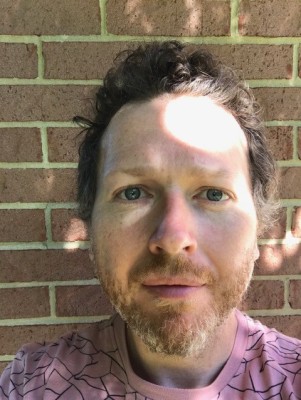
M.S. Reagan, originally from Pittsburgh, Pennsylvania, is a writer and MFA candidate at WVU in Morgantown, West Virginia. His poetry appears in Appalachian Review, and he was a finalist for the 2024 New Ohio Review Literary Award in Creative Nonfiction.
Tornado Family
May 31, 1985. Hell is an obsidian cloud that comes from Ohio: a womb spawning forty-four siblings that scrabble eastward across Pennsylvania, New York, and Ontario. In eight hours, 90 will be dead, 875 injured.
Mom takes me to Pennzmart to buy popsicles. I choose a blue freeze pop. We sit in the living room eating our treats while Dad retches with pneumonia. I suck every last blue drop from the clear plastic wrapper.
Behind our house, just beyond the hill, sky becomes land and land becomes sky. The giant smudge traces the topography.
Wrappers and sticks disposed in the kitchen, Mom looks out the window to the western horizon—pillar of darkness closing in. Then sound, not for ears, but for skin, for pores. Sound felt, known, the way a snake in a hole under the tracks knows a train.
She scoops up my year-old brother, grabs my hand, takes us to the basement. Slow to rise, Dad tries to close windows as they blow into his chest.
I huddle under an old wooden table with my mother and brother when it begins. She squeezes us, screams my father’s name, prays to Jesus. The room animates with flying objects. I feel something brushing against me. At four years old I have the sense, somehow, that death is tapping me on the shoulder. But it is my father’s arm. He shields us with a piece of old carpet—gets gashed by flying glass. Trees lance the cinderblock foundation, our last sanctuary.
Unreality is when time does not exist. Time does not exist in the belly of a tornado. Only sound.
Father, mother, brother, self—together under the table. Warmth of our bodies pressed as one, my legs cold against the cement floor. Every particle undoing itself. We are being ingested.
Then the gradation to stillness and silence. Then the overwhelming urge to flee.
We escape the wreckage by climbing over piles of cinderblocks, a washer, a refrigerator—scooting our way atop my dad’s black muscle car. The sky is algae. We are halfway through the yard when Mom panics about live wires. Survive a tornado, but death by electrocution? We stop. Then Dad gets irritated, says we can’t just stand there. So we press on.
We take refuge at our next-door neighbor’s, briefly, then embark across their field. The sky has changed, slathered in sublime pinks and oranges—more beautiful than anything any of us have ever seen. We linger in awe.
Our encampment is at another neighbor’s, a tan brick ranch-house, cozy, still standing. I’m greeted by my best friend. We play with his toys, and I’m pleased when told I’ll get to sleep over. Morning is the nightmare. The valley: sheared. Our white siding house, stripped of its roof and made airborne while we were in the basement, resembles a teetering box of saltines. We enter one last time to sift through the chaos. My aunt takes me to my room. I cannot enter because its hardwood floor slopes away steeply, like a room in a carnival funhouse.
What’s left will be bulldozed and burned.
My parents will ask the difficult questions: What if we hadn’t gotten popsicles that day and my mom wasn’t in the kitchen to look out the window? Just how did my father get into the basement when he doesn’t remember going down the stairs? How did my mom’s wedding ring end up under the waterbed? How did a half-gallon block of ice cream from our freezer (still frozen at the time of discovery that same evening) get buried a hundred feet away in the field like it had been planted?
I will find a hatchling robin lying in the yard and tell it not to worry, that I too lost my home.
My mother will take me to children’s group therapy. Before the first session, when I get out of the car, she will realize that I am wearing a He-Man shirt that says “Master of Disaster” and feel so self-conscious that she will make me turn the shirt inside out. I will be very unhappy about this. In the group we will blow into plastic drinking straws. Blobs of paint—blue, red, yellow—will swirl greenly into one another on white paper plates.
Later, in the wasteland, killdeer will move in and roost on sandstone chips and clay.
My parents will choose to rebuild a new pale red brick house on the same foundation. They will sit together on the big couch, flanked by guests becoming more than acquaintances. They will peel through plastic pages of devastation in photo albums, tell our story, and—from the carpeted floor where I am supposed to be playing with the other kids—I will listen and learn it by heart.
Later still, the woods will return—stands of black locusts—strong as iron.