
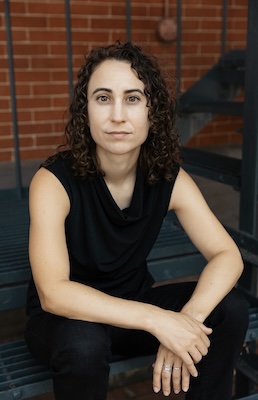
Kate Broad
fiction
Kate Broad is the author of the novel Greenwich. She is a Bronx Council on the Arts award winner for fiction, and her work appears or is forthcoming in The Rumpus, No Tokens, The Brooklyn Review, Bellevue Review, Electric Literature, LitHub, and elsewhere. Kate has a PhD in English from the CUNY Graduate Center and a BA from Wellesley College. Her website is https://katebroad.com/.
Lipstick
All week the boy counts down. The new kid is coming over, and the boy himself made it happen. At recess, pushing out the words: Do you wanna? The nod so quick he almost missed it, distracted up close by freckles, grass stains, earth.
A new kid should be sad to have moved and left his old life behind. Grateful to the boy for his toys and his jokes and his kindness. But when the day arrives and the new friend is deposited on the doorstep, his father already driving away, he isn’t shy like at school when he has no one to talk to. He shrugs at the boy’s trucks. He’s already done the Lego kits. He nudges something small, hard, on the carpet with his socked foot, then picks it up before the boy can stop him.
A golden tube, bright as the boy’s glittering shame.
“What’s this?” the friend asks, and uncaps it. The waxy red is smudged down to a stump.
“Yuck!” he cries. “Is that lipstick? Is it yours?”
The boy wishes he knew what game they’ve started. What the rules are and how not to break them.
“It’s my mom’s,” he admits. “My sister plays with it sometimes.”
“In your room?” The friend considers the small, bullet-shaped thing as though it’s an actual bullet. Something dangerous in the boy’s bedroom, which consists of Legos and board games and books, so many books, and stuffed animals, although not as many as in his sister’s room. And some dolls, but he’d at least known to hide those away.
“My mom makes us,” the boy says, and the friend’s eyes narrow. Worse than playing with lipstick is not standing up to one’s mother.
“That’s disgusting,” the friend says. “Don’t you know that lipstick is disgusting?”
The boy finds a flap of skin along his thumbnail and tugs. His mother wears lipstick, and she isn’t disgusting. His sister burps at dinner and farts in the tub and he still feels bad about the time he pushed her in the driveway and skinned her knees so badly that afterward she peeled the scabs and flicked them at him while he screamed how gross she was.
But that’s different. Words turn funny when he writes them over and over, practicing for spelling tests. Pencil. Adventure. He repeats disgusting in his head until he’s no longer sure what it means.
He looks up to find his mother in the doorway.
They haven’t closed the door, and the boy worries what she’s overheard. He’s less afraid of anger than he is of disappointment. He wants to take the gold tube and say to his friend, “Close your eyes.”
He’d press his fingers to the friend’s thin lips. His freckled skin. Pale as unripe fruit. The boy wants, suddenly, to bite it. He’d coat the friend’s lips in berry red, in cherry juice, and the friend would be open and patient with him the way the boy is open and patient when his sister smears it on him, too much and too thick, not the way his mom does where the boy knows it will turn out just right.
That’s the only thing that stops him—his fear of doing it wrong. He won’t be able to show the friend the transformation, and the friend won’t understand. He won’t see for himself, then. See who he could become.
Because what are they doing in the boy’s room besides pretending? Playing dress up every second of their lives. It’s all a game, it’s always a game, even in their robot shirts and cargo shorts and Nike socks pulled high.
In the mornings his mother transforms into her dress slacks and silk shirts with a crisp blazer on top. She wears sneakers to walk to the train, and then, like magic, another transformation: pointy shoes with a sensible heel, glossed to a hard candy shine. Coming home, the reverse again: the heels swapped out, the suit to its hanger. When the boy lies in her lap, he likes to stroke the hem of her soft t-shirt between his fingers while she teases his hair. Everyone is always changing, always turning into someone else. Why can’t the boy and his friend do the same?
His mother says his name, sharply, and says the friend’s name.
“Let’s go outside,” he says to the friend, trying to lower his voice the way his father does when he wants something, from the kids or from their mother or on the phone when he isn’t getting his way. “It’s so boring in here.”
The friend drops the lipstick with the cap still off, and they race downstairs.
Later, after the friend is gone, not to be invited back again, the boy walks slowly to his room to meet his punishment. He finds his mother crouching over the carpet, prying up the red wax with a butter knife and spraying at the stain.
She looks up at him, their roles reversed: she on the floor and he in the doorway, not liking how it feels to tower over her. He waits for her to say it. Why do you never stand up for yourself? Why do you only run away?
But she rises and kisses his forehead, and this is somehow worse. “My beautiful boy,” she murmurs, and then she kneels again. No yelling, no lecture, no lesson. Only scrape and spray and blot, the stain still visible to him long after it’s gone.
“ A friend was texting me about the challenges of raising a feminist son, and the relentless messaging he receives from other boys his age (not to mention the world at large) around what it means to be a man. The word ‘disgusting’ came up to describe ‘girl’ things like lipstick, and this story immediately took shape. I knew I wanted to tell it from the boy’s perspective, not the mother’s or my own. I’m always interested in what characters don’t know or can’t quite articulate, and the tensions in what’s left unsaid. ”