
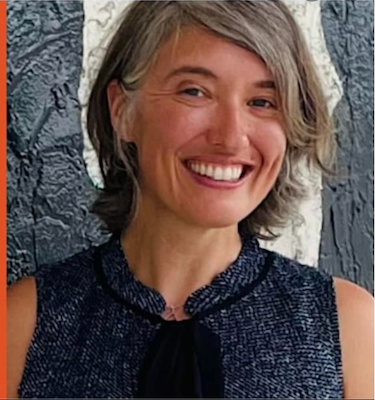
Julie Marie Wade
fiction
Julie Marie Wade’s recent collections include The Mary Years (Texas Review Press, 2024), selected by Michael Martone for the 2023 Clay Reynolds Novella Prize; Quick Change Artist: Poems (Anhinga Press, 2025), selected by Octavio Quintanilla for the 2023 Anhinga Prize in Poetry; Fisk, By Analogy (CutBank Prose Chapbook Series, 2025); and The Latest: 20 Ghazals for 2020 (Harbor Editions, 2025), co-authored with Denise Duhamel. A finalist for the National Poetry Series and a winner of the Lambda Literary Award for Lesbian Memoir, Wade teaches in the creative writing program at Florida International University in Miami and makes her home with Angie Griffin and their two cats. Her newest memoir, Other People’s Mothers, will be published in September 2025 by University Press of Florida.
Swimmingly
Sally sells seashells by the seashore, just like you’ve always heard. Sally sleeps in her Subaru by the seashore, just like you haven’t. Sally keeps a silver dollar she will not spend in the glove box of that car. She’s thought about it once or twice, tossed the coin to determine if she should. The silver dollar always lands heads down. Keep. Good luck charms are priceless after all. Most nights Sally moves her Subaru from the boardwalk parking lot deep into the beach grass, turns off the engine, lets it roll. She doesn’t want to get booted, and besides, she likes the way the tall blades susurrate while she falls asleep. Even as a child, camping on the beach, she loved falling asleep to that sound.
Sally still sells seashells some days, accepts her fate as an unsuccessful entrepreneur. “Maybe try a lemonade stand or something,” a surfer dude said. “I mean, have you looked around? Most seashells are free, cuz, ya know, the sea is right there.” He did have a point. What about an orange juice stand? Wouldn’t Floridians want to sip their state fruit while sprawling on the warm sand? Wouldn’t out-of-towners want the same? “Nah, man, I’m thinking Gatorade. Flavored orange but with all those extra electrolytes and shit.”
She hadn’t asked for his input, but he gave it anyway. This happened a lot. Kite-boarders and scuba-divers were also quick to weigh in. Gatorade, named after the University of Florida Gators, named after the everywhere-in-Florida gators. Alligators aren’t endangered anymore. For 20 years, they were. Alligators came back from the brink of extinction in 1987, the same year Sally left for college. Sally might come back, too, if the federal government ever forgives her student loans. She applied for forgiveness on a library computer. “Remember when all it took was a prayer?” The man next to her spinning in his chair, printing blurry, black-and-white stills from the porn on his screen.
“What did you say?”
The man whistling through the gap in his teeth. “Forgiveness used to come standard as a clutch.” He splayed his wide, Christ-like palms—“you know, with God and such. Forgiveness was the package deal.”
Sally didn’t nod her head. Sally had always been wishy-washy about God. Sally still sells seashells, but further up the beach, by the hip new restaurant on pilings. She makes necklaces, anklets, and wreaths out of shells, charges her glue gun overnight through the cigarette lighter in her car. That Subaru is so old it still has a cigarette lighter and hand-crank windows, no A/C. Sally calls the Subaru “Fronds” because of its light green color. She got the car in a lesbian split before the law recognized her marriage—let alone her divorce. Sally still sees her ex at the college sometimes, where Sue has a tenure-track job and may be dating a dean. For now, that rumor is unconfirmed.
Sally picks up a section of Intro to Lit every now and then. $1500 a class. No benefits. She has graded by dome light, graded by moonlight, graded by streetlight near the bathroom stalls. Pens are cheaper at Publix than Walgreens. Sally has a flip phone and a post office box. Sally eats a lot of bananas and Luna bars. Sally has strong legs from walking miles on the uneven sand, but her hips hurt from walking miles on the uneven sand. Generic Aleve is cheaper at Walgreens than Publix. Sometimes Sally mixes orange Kool-Aid powder with water from the public fountain, pours it into Solo cups she buys at Family Dollar. “Get your souvenirs and Gatorade here!”
The surfer dude raises his thumbs in the air. “Took my advice! Nice!”
Sally listens to soft rock on the Subaru radio. Sally showers under a rusty spigot at dawn. Sally isn’t too proud to browse the dumpster behind the beachside shops. She has swum out too far, has been in too deep, has failed to heed the lifeguard’s silver call. If you ask how she is, Sally will always say, “Doing swimmingly,” and doff her visor. Why should her hard luck dampen your day? Sally would be the first to admit, having swum with both tarpons and sharks, it’s hard to tell the difference till you’re bit.
“ When I began writing ‘Swimmingly,’ I thought I was writing a prose poem. (Who knows? Maybe I was!) I had the idea that I wanted to explore various idioms and tongue-twisters that I grew up hearing and consider what would happen if I literalized them. ‘Sally sells seashells by the seashore’ was the tongue-twister I heard most frequently growing up, perhaps because I came of age by the seashore—about a mile away from the rocky beaches of Puget Sound in West Seattle. For all the time I spent at the beach as a child, I never saw anyone selling seashells. There were so many shells, and they were always free. The marketplace would not have been lucrative. Now I live on the other coast, also about a mile from the seashore. Hollywood Beach is where I spend much of my time, running and reading and beachcombing at the edge of the Atlantic Ocean. It's a beautiful place, but there are perennial reminders of those experiencing homelessness in our community—people who sleep at the beach, shower at the beach, forage at the beach, people who have nowhere else to go. The immediate reality of where I live now began to shape an identity for Sally, and the fact that I am a tenured professor who was once an adjunct professor—who also knows many adjunct professors who are struggling term after term to make ends meet—informed my thinking about the perilous financial state that so many educators find themselves in, not through any fault of their own but through a failure of our educational system to provide adequate pay for all its members. This constellation of concerns conspired to reveal Sally to me and to share her, in flash fiction form, with my hoped-for, future readers. ”