
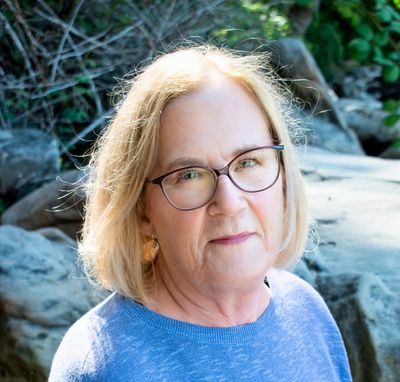
Betty Ruddy
creative nonfiction
Betty Ruddy’s essays have appeared in, among other places, The Fourth Genre and The Journal, and two of her essays were named Notables by Best American Essays. She has an MFA in Writing and Literature from the Bennington Writing Seminars. She lives in the Pacific Northwest where she writes about such disparate subjects as the human body and foster care.
Searching for the Fifth Sense
I used to have a nose. Of course, I don’t mean that protuberance in the middle of my face through which I breathe. I still have that. Rather, I mean that the scent of an old book could transport me back to the children’s nook in a small-town library. I could talk congenially with others about the smells and tastes of a good meal. My whole world was scented: purple lilacs in the spring; an overflowing garbage can; the top of my baby’s head, her milky cheek; a pile of musty leaves. You will have your own list.
All that has changed. My sense of smell has been declining for years. Now it has all but vanished. Other than a couple of random odors—the occasional whiff of chemicals in my kitchen faucet water or smoke from a wood-burning fireplace—I smell nothing. The least-appreciated of the five senses has skulked away, making off with a part of me, stealing more than I realized at first.
Many have written about their experience of losing a sense of smell after contracting COVID. Fortunately, most of those sufferers eventually regained it. It was twelve years ago, long before COVID, when I realized that my sense of smell was all but gone. It has never returned. It probably never will.
The doctors can’t tell me why I have anosmia. Most likely, something in my olfactory system has gone awry. It is a system different from that of other senses. We see because of light waves and hear because vibrations create sound waves, but smell is more direct. When you take a whiff of a rose in your garden, the actual molecules thrown off by the flower float high into your nasal cavity where they latch on to olfactory receptors. The nerves triggered by these receptors transport the signals from the nose to the brain’s olfactory cortex. There they are sorted and arranged in order to produce the rose’s unique scent.
The millions of nasal receptors in a healthy nose are naturally replaced every four to six weeks, but this process can be permanently damaged by disease, smoking, allergies, trauma. My nose was most likely injured by years of untreated low-grade sinus infections, my nasal passages made wooden by inflammation. Or maybe it was the fact that I smoked earlier in life. Or maybe it was the time, as a child, when I took a big whiff from a bottle of hydrogen peroxide and burned my nostrils. I’ll never know for sure. I used to wonder whether I failed my body or it failed me, but I see now there is no answer and maybe it doesn’t matter.
Age would have caught up with my nose anyway. As we get older, replacement of nasal receptors slows, in my case, at a more rapid pace. Aging is about loss, the inevitable piling up of losses. Losing my sense of smell was my first—rather quickly arriving, much too early—brush with growing old.
I have glasses to correct my astigmatism and appliances to help me hear. There is, however, no “smelling aid,” no drug to take, no device to be implanted. There seems to be no way for me to smell without actually smelling. Can this sense, however, be restored?
On the corner of my kitchen table sits a small white box. It contains four small plastic tubes filled with essential oils, one for each of the most prevalent, identifiable scents: clove (spicy), lemon (fruity), rose (floral), and eucalyptus (woodsy). The oils were suggested by my doctor as the only known way to retrain this sense. I hold the tubes to my nose and breathe them in, one at a time, for thirty seconds twice each day. My nose can detect the scents when they are concentrated like this, especially because they are so familiar, but only when I put them right up to my nose. In a small 2009 German study of these oils, thirty percent of the anosmic participants experienced some improvement after a few months. Not particularly good odds.
At least I am not alone. Even before COVID, there may have been as many as two million anosmics in this country. There is even an Anosmia Awareness Day, February 27. It is not a holiday printed on my calendar.
~
Of all my scent memories I treasured before I lost the sense of smell, one in particular most often comes to mind.
I burrowed my nose into my lover’s neck and inhaled deeply. “You smell so good,” I told him. “You smell like you.” His scent, together with his dry humor, broad shoulders, and many unnamable traits, was an essential part of the “you-ness” I was drawn to. It seemed to enter my core, to make me want to settle my body next to his.
“What do I actually smell like?” he asked, laughing.
The closest I could come to naming the scent was “Olives.” The odor that rose from his skin, the one always present under whatever sweat or salt or dirt lay on the surface, brought to mind the slightly sour, not at all unpleasant, scent of green olives. I now know this was his “odorprint,” which scientists say is as personal and unique as a fingerprint or DNA sample and is transmitted through sweat and urine. Among other things, it helps us pick a mate.
This is why I pick up those tubes every morning and why I pick them up every evening: the hope that their contents—waxy, encased in plastic though they be—will recapture a scent like this. A scent that strums the strings of something deep in my body and makes it jump and quiver.
It doesn’t seem like I’m asking for much given the plenitude of aromas. We are capable, scientists say, of recognizing ten thousand odors. But these odors add up to many more smells.
The essence of my favorite coffee shop isn’t just coffee beans, but cocoa, nuts, and milk, tangy leather booths and homemade chocolates. The smell of a new car is very distinct but comprises many odors: new leather, air freshener, rubber floor mats. And then there are those odorprints. I figure, since there are 7.6 billion people on this planet, there must be at least 7.6 billion smells. Maybe more. Although its results have recently been challenged, one study suggests a trillion.
At first, the loss of all these odors seemed rather inconsequential. It had no bearing on my daily life; I continued to work, drive, see family and friends. But over time, the loss deepened. When I began smell training, the scents in the tubes resonated with me. The clove reminded me of baking cookies and Christmas. The eucalyptus seemed to reach its scent tendrils into something primordial deep inside me. Smell is indeed the most primitive of our senses; it was the first to arrive on the scene. It is suggested that even the earliest life forms had something like a sense of smell. As Diane Ackerman, in A Natural History of the Senses, describes, the cells producing the ability to smell were “so successful that in time the small lump of olfactory tissues atop the nerve cord grew into a brain. . . . We think because we smelled.”
Smell is so important that we have more genes for it than sight, hearing, or touch. Maybe, we don’t need smell as much as early humans, who would have used this power to identify the “other,” be it tiger or human predator. Yet, even today we rely on this sense to protect us from physical dangers such as the smoke of a house fire. We put mercaptan and sulfides, which smell like sulfur, into otherwise odorless natural gas to warn of a leak. Now that I’ve lost my sense of smell, I’m left to the mercy of mechanical devices and must have faith they will function properly. While their failure might be disastrous, there is little more I can do about the danger so I rarely think about it. I do worry about the safety of food that has migrated to the back of the refrigerator shelf. Whether it’s raw fish I haven’t gotten around to cooking or leftovers in their little plastic containers, taking a sniff or a taste tells me nothing. I throw away a lot of food.
The dangers aren’t always so concrete. I remember a girl in my third-grade class, with dark red hair that would have been beautiful if hadn’t been matted and greasy. Every day she wore the same green plaid dress that was sorely in need of washing. I felt guilty snickering behind her back with the other kids, but the odor was unpleasant, and I worried that if I spoke to her, my classmates would turn against me, as children, with their instincts about tribes and outcasts, will do. Somewhere deep inside me, too, was the fear that her stigma—or the odor itself—would rub off on me. Not an unreasonable thought since an odor comes from absorbing the tiny particles of an object. Being close to her, as with sitting on the bus next to an unwashed passenger, felt, in some primal way, like danger.
About this time, I made what felt, in my childlike way, like an important discovery: every house had a unique aroma. I figured I didn’t notice that of my own home because it was so familiar, but my grandparents’ house was infused with my grandfather’s pipe tobacco and my grandmother’s homemade sugar cookies. You could have set me down blindfolded in their front parlor, and I would have known immediately where I was. Once, I went to play with a classmate who lived in an old Victorian house, the first time I visited an unfamiliar family without my parents. I was a little spooked by the old-fashioned furniture, but it was the odor that disturbed me most. It wasn’t as distinct as cigarette smoke or garbage or dirty diapers. More like a mixture of old damp wood, disinfectant, and talcum powder. The sourness belonged to these people only, and here I was, it felt to me, an outsider peering past the family’s outward veneer into a life of cooking, eating, drinking, bathing, sleeping and, without the words coming to me, making love, defecating. Something—if not unseemly then certainly hugely private—lurked there, seeping into the staid living room, escaping the secrets of the bedroom and bathroom. My stomach twitched. I found myself turning inward. My classmate’s house smelled not just different. It smelled of the “other.” Maybe this was a place I wasn’t supposed to be.
~
Sensory signals from all over our bodies travel to the brain, telling it that we are too close to a hot stove, or that we are looking at a beautiful sunset, or that church bells are ringing. Most of this sensory input travels to the part of the brain called the thalamus, the body’s relay system, where the input is analyzed and sent on. Smell is different. Once our noses detect a scent, the olfactory system bypasses this analytic step and sends signals directly to the limbic system, the part of the brain from which spring our memories, our feelings, our lust, our creativity. Ackerman again: “Unlike the other senses, smell needs no interpreter. The effect is immediate and undiluted by language, thought, or translation.”
This is why memories are like dreams, difficult to describe but still weighing us down with emotion. Marcel Proust understood that the ability to smell is a gift of remembered moments. My personal madeleine is a summer yard. Before I lost my sense of smell, when I walked outside on a mid-summer morning, I was greeted by a sensation that felt mine alone. My backyard was hot sun, lush leaves, and heated earth blended into one unique sweetness that reminded me of summers growing up in the country. Back then, when I ran outside after breakfast, the air was as ripe as fresh peaches and pregnant with possibilities inherent in another long day as a child with few responsibilities and little adult supervision. As an adult, I looked forward to hot weather so I could walk outside and soak in that “youngness.” My body felt both smaller, like a child’s, and larger for being filled with joy.
I find that I’m describing odors by referring to what produces them (lush leaves, heated earth). With other senses, similes work (“the winter air was as cold as the inside of a freezer”), but smell is notoriously difficult to put on paper. And yet I strive to do so, as if not being able to detect an odor makes it more urgent that I find the vocabulary to write about it in a nuanced way. It’s all the more challenging because as we age, word recall is one of the first things that fades.
I’ve now reached the point where my remembrance of experiences is no longer based on visceral memory but on recalling the words I attach to it. A “sense” of smell two or three times removed from the source. Attempting to conjure up an aroma, for me now, is like trying to experience an emotion I don’t feel.
Maybe our senses are designed to work together, the total effect greater than the sum of its parts. Have you ever lain in the dark at night and thought you heard a worrisome noise, then sat up to turn on the lamp, thinking the light will help you hear better? Or take taste. This sense originates in our taste buds, but the taste receptors send sensory messages, not directly to the brain, but to that olfactory area in our noses. This is why smelling a food enhances its flavor, and why having anosmia interferes with my appreciation of taste. Especially with food with volatile molecules, such as cooking meat, where taste relies so much on smell. To me a steak tastes like spongy cardboard and bacon like strips of leather. The taste of sugar doesn’t rely on smell, however, and every day finds me trolling my kitchen cupboards in search of something sweet.
I’m beginning to ask myself whether something as artificial as smell training can change what nature has in store for me. Will I ever again experience a scent that vibrates inside me? I’ve been doing some digging and discover that, unfortunately for me, the efficacy of smell training decreases with age.
~
The other day, when I walked out the door, I did a quick check. Keys? Wallet? Phone? Glasses? I paused. As has been the case for many years, there was one last thing I couldn’t verify. I didn’t want to be like my unfortunate third-grade classmate, so I wondered: do I smell all right? Despite my attention to hygiene, is my body off in some way? Do the odors from last night’s baked fish and stir-fry broccoli linger in the air or on my clothes? I was filled with a buzzing anxiety.
Health professionals know anosmics are more likely to be depressed. I don’t think I am, but I can’t deny a little bell rings inside when I consider the possibility. We all want to fit in, if only with family or a few close friends. We don’t want to offend or be humiliated. I don’t want the good and true parts of me to be overshadowed by the way I—clueless and guileless—smell.
Is this what it feels like to be old? Isolated, fearful, self-absorbed?
Twenty-seven percent of women age 65 to 74 live alone. After age 75, the figure is even higher, 44 percent. “Do I smell bad?” For those of us in the 44 percent, who in the world would we ask such a thing of?
As I straggle through my 70s, facing reduced strength, stamina, and flexibility, anosmia has chipped out one more piece of the whole person I used to be. I’m not just a different person than I was before I lost my sense of smell. I’m also different than what I could be at my age; my affliction makes me old.
Once I was at an ocean beach when several young men in their twenties danced out of the water with their surfboards under their arms and ran for the outside shower, where they stood jostling each other under the showerhead, the water streaming over their muscled bodies. I couldn’t help thinking the boys’ bodies were at their peak. Maybe their comfort in the world or their relationship abilities were not well developed; nevertheless, they moved with an ease that was enviable. They were about as physically strong as they would ever be.
But change was coming for them. In not too many years, around age thirty or so, their bodies would begin their decline: cells deteriorate, bones thin, spinal discs shrink, organs and blood vessels stiffen, body fat replaces lean tissue, senses dull. Just when humans reach their physical peak, the body will take the first steps on the inevitable road to old age and death. Maybe the purpose of aging is to teach us to accept the absurdity of death.
It all makes me wonder what my death will be like? Quick like my father, who died of a brain aneurysm? Or slower like my mother, whose heart finally gave out after years of heart disease? When I trip on the corner of a rug because I’m shuffling my feet, I think, oh, this is how I’ll go: a fall, then broken hip, then pneumonia. That’s how you hear it happens. Or maybe I’ll forget to turn the stove off and won’t smell the smoke.
Of course, we can’t choose. (Even a friend of mine who swore he would swallow a bottle of pills at the end, could never bring himself to do it.) Sure, a healthy diet and exercise are good for keeping our bodies from early decrepitude, good, too, for our mood. Still, they are ineffectual shields against decay and the inexorable tramping of time. The actuaries say I’ll live to 87. Maybe. Fate is fickle.
~
The routine of sniffing the oils is getting tiresome, and I rarely do it these days. I’m like the many anosmics in scientific trials who can’t sustain the discipline required by the regimen. I also read the even more discouraging news that where sensory loss is, as in my case, idiopathic—of unknown origin—the recovery rates are quite low. It seems that research on smell restoration has made little progress. There are nascent efforts to create a biosensor, but, even if successful, it will not arrive in time to help me. I’m ready to give up the idea that someday I might be able to smell something important. That someday I might be able to hug my children and grandchildren, inhale deeply, and feel the strong cord that binds their sweet hearts and mine.
Really, it would be foolish to pine for the days when I could smell. Just as it would be foolish to believe I will never grow old.
But we are foolish. When we are children—or adolescents, or even young adults—it seems impossible that we will grow old. Our parents, our grandparents: sure, they’re old. But to us they have always been so. Around forty, we might be able to envision ourselves as fifty or even sixty-five. But eighty? Graying hair, shriveling bodies, suspect memory? No way. Refusing to acknowledge the natural order of things, we view being as old as eighty as a world apart, a world we never intend to enter.
I am poised between the past, when I was a self I recognize, and the future, when I worry I will become a caricature of myself. I can no longer pretend not to see what lies ahead. Actuarily, I’m 87 percent of the way through my life. I anticipate the last 13 percent will be much different. I’m not much concerned about wrinkles and sagging skin, but, even if I manage to avoid serious illness, my energy will slowly deflate like a balloon, my step will be less sure, my memory will continue to seep away. I vowed these things would never happen to me, but of course they will.
At 50, “old” to us is 65; at 60, it’s 75; at 75, it’s 90. It’s always 15 years older than we are at the time. So, when we arrive at true old age, we are a bit stunned by how things have turned out. We are no longer working, or if we are, we may no longer be as relevant. Raising our families is mostly done. Maybe at family gatherings our voices aren’t heard. It’s almost as if we’ve become invisible.
Can I adopt a brighter outlook? I think I am wiser about human nature; I see more clearly both the best in people and the worst. Undistracted by much of the outside stimuli, I can think more clearly. I care less about how I appear to others, what they think about me. I have time to do what I want to do. Yet, these benefits, if that is what they can be called, all have a negative side. I may have more time, but I have less energy. I may care less about what others think, but my others are getting sick and dying.
Yes, there is plenty to dislike about being old and then to top it off, at the end there is this event that, no matter what, cannot be rescheduled. We are told we should accept our new status. I find the word “accept” unhelpful, really. I won’t accept in the sense of giving in or saying “yes” to this stage of life. I won’t concur or surrender. Still, I can’t help but acknowledge the power of aging and respect death’s inevitability. My body will follow the course that nature has laid out for me. Resistance is futile.
But fight we do. I try to keep a young attitude. Others focus on keeping their bodies strong. Some decide to travel or take up some new hobby. We do not go quietly. The human spirit compels us to fight to stay whole, fight to live, fight to go on, to flourish even. Even as we know that our fight will not prevail, that, in the end, death will triumph.
My greatest consolation comes at night when I lie awake wondering about it all. Maybe a dog will bark, or the moon will peek in the window, and I am reminded that these small wonders, coming to me with my remaining senses, have been mine. I take solace in the amazing fact that I’ve lived life at all.
“ For the last couple of years, I have been trying to capture in words the elusive sense of smell, and the way that losing mine has set me apart. Finally, despite my compulsion to keep revising, it has come to fruition. At 78 years old, writing is still what sets my mind on fire. ”