
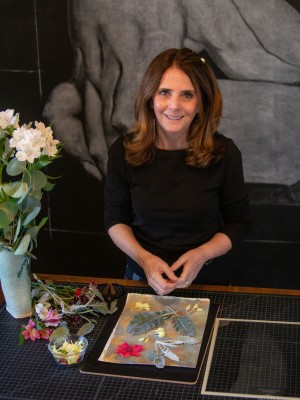
Beth Kephart
creative nonfiction
National Book Award finalist Beth Kephart is the award-winning author of some 40 books in multiple genres, an award-winning memoir teacher, co-founder of Juncture Workshops, a paper artist, and the author of the Substack, The Hush and the Howl. In 2025, My Life in Paper: Adventures in Ephemera (Temple University Press) was named a finalist in the 2025 Pattis Family Foundation Creative Arts Book Award. Tomorrow Will Bring Sunday’s News: A Philadelphia Story (Tursulowe Press) won the FOREWORD Indies Editor’s Choice Prize in Fiction. Beth’s paper art and visual poetics appear in Print (digital), Qwerty, Calyx, Redivider, The Pinch, Reed Magazine, Indianapolis Review, Black Warrior Review, and elsewhere. Her new book, the illustrated Conversations with Women in Blue: Cyanotypic Dreams, will appear in March 2027 from Wolfson Press. More at bethkephartbooks.com.
Fine Adjustments as You See Them
He arrives with an amalgam shape—is it a torso? is it a bone?—reproduced from a book he keeps among the paints in his studio. Also: A piece of shiny virgin paper. A red mechanical pencil gripping stubby graphite that he sharpens then returns. A kneaded eraser. A purple cross-hatched mat brought up, along with its dust, from the clay basement, which now he cleans and places on the dining room table.
Try drawing the shape, he says, and leaves you alone in oblique angles of the sun.
You know not to ask any questions, not to hum.
When he returns and looks over what you have done, he says, Not bad.
Tomorrow he produces Bargue Plate 1, 9, which proves to be a drawing of a foot—a gridded, chunky version of yesterday’s shape, with additional details. You hadn’t guessed, would not have guessed foot. A foot is complex, he explains, and therefore worthy of the mission to teach a woman who emphatically cannot draw and who is now, of forty years, a wife.
Everyone can draw, he says. And: Drawing is hard.
Together you grid a fresh sheet of drawing paper, matching the Bargue grid precisely. Now, producing a bamboo chopstick which he prefers to a ruler, he begins to mark the distance between the Bargue foot and the grid. Lays the stick down, strikes a mark across its back, lifts the stick with its mark and transfers it to the page you have just gridded. You are constructing, it soon becomes clear, a dot-to-dot. The place where the tip of the big toe’s shadow touches the left bottom quadrant. The place where the right curve of the heel begins and the place to which it rises and the places where it, curvingly, descends. Dot by dot. This is a foot seen from below. It seems very complicated.
Once the dots are in place you will connect them, he says, showing you how to hold the pencil and telling you to use your arm at least as much as you use your hand and calling it all a searching line because you are on a journey, traveling toward the bare curves and angled straights between the dots.
You are just searching for the lines, he says again. Instead of, you guess, drawing them.
He leaves you to the sun. You quell your panic. When he is almost out of the room, he turns. You can erase the dots and the lines as often as you like, he says. That is the purpose of the kneaded eraser.
You will come to depend on the kneaded eraser.
Your drawing is not bad, he says, when he returns. Actually, he says, it’s pretty good. Words that leave you shaken. You have waited your entire marriage to hear him praise, with authentic, unguarded enthusiasm, something you have made, beyond the dinners that you cook. Something about the books you write is something he has never wished to read. Something about the talks you give—the ones he attends because they are too far for you to drive, or because you need help carrying the wine and cake, or because friends of his will comprise the audience—does not interest him. It was good, he’ll say, with a shrug in his voice, but only if you ask him, so you don’t much ask him anymore. So that this unsolicited pretty good cracks open the bones in your chest.
Though, be honest, what you have on your page is a rough dot-to-dot. That big toe and that slight bunion curve and especially the right side of the heel are all so clearly out of alignment. Which is the subject of the next lesson—refinements. The drawing lesson now having moved to the place where you make your abstract, never-realistic art, toward which, it should be said, he has always been kind but never awestruck. Here, at the tall table, you stand beside him, giving your arm more latitude to lead your hand toward the better lines, the truer drawing. Every wrong line has a consequence, he says. You want, at the very least, your large spaces to be right, and one approach would be to study the negative spaces, and one would be to use your fingers, now, to measure, and one would be to stand back and look, with care, at the drawing you are making. Is the foot wide enough? Does the curl and overlap of the toes produce, between them, the right shadows?
The foot grows more foot-like.
The next day: shading. You are to create a gradient, leaving a third of the rectangle he marks out on the left margin of the page pure white and building up from there more and more and more darkness until you have built a seamless progression of whites and grays. You are to think of the shaded areas in terms of pixels. You are to cover those pixels, bit by bit. The transitions between the zones of grey are shades, too; they are the gradient.
This is far harder than it sounds. You will return to that lesson the next day. He will agree with you that gradients are indeed far harder, especially given the tool he gave you to work with, that chubby stub of graphite that prefers not the dark and not the light, but a small range of middle tones.
Yet again, you persist. You wish to prove that you have this in you. You wish to draw and shade and lift a foot that is a foot heading off in the right direction.
“ ‘Fine Adjustments’ feels like the story I could be writing every day as I move increasingly toward the making of visual art with curiosity, frustration, and hope. ‘You can draw,’ my husband asserts, a new mantra. Followed by ‘Anyone can draw.’ I am not so sure. Not at all. But I can try, and that is what I am doing, returning to words as my familiar country between the journeys I make into the land of the strange.”