
Quiet and Loud, Present and Absent: An Interview with Jeannie Vanasco
by Jill Sisson Quinn
The silent treatment. We’ve all gotten it–or given it–at one time or another. But what if you’re a writer, and your mother, not for the first time in your life, stops talking to you for an extended period? And this time, it’s after you invite her to move into your home and she willingly agrees? Well, then you get Jeannie Vanasco’s third book, A Silent Treatment. Even in the absence of words, Vanasco finds a complex story.
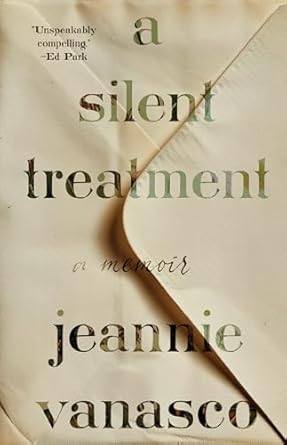
In this metacognitive memoir cut from the same cloth as her earlier books, The Glass Eye and Things We Didn’t Talk About When I Was a Girl, Vanasco explores the psychology behind giving the silent treatment, the psyche driving her mother’s silent treatment, and her own persona as daughter.
I asked Vanasco, associate professor of English at Towson University in Maryland, a few questions about writing and relationships.
What is your writing practice? Do you write every day?
I write most days, but I avoid strict schedules or routines. I use notebooks, notecards, scraps of paper, book margins, my phone’s Notes and Voice Memo apps, Google docs, Word, email drafts, binders. But sometimes I treat a binder like it’s a closet before company comes over. I shove everything inside and pray nobody opens it. A few months ago, I found—in a closet, no surprise—a spiral-bound notebook labeled A Silent Treatment. I’d never transcribed it. Finding it felt like finding cash in an old pair of jeans. I’ll use it for something else.
Can you talk a little bit about structure? Your book consists of a mix of full paragraphs, word association, near-poems, lists, transcripts of thought. How do you structure a chapter? How do you go about structuring a book?
I want structure to reflect experience, but only after writing a full draft do I start to see the structure—specifically how structure and conflict connect. I mean, it’s all connected: character, plot, setting, all of it. The silent treatment itself is conflict, but for A Silent Treatment, I needed to vary the forms of conflict. The conflict couldn’t just be: my mom isn’t talking to me, my mom isn’t talking to me, my mom still isn’t talking to me. So I thought about other forms of conflict, especially with other characters, like when Chris said, “Why don’t you just go down there and talk to her?” And I came up with all these reasons why I couldn’t. That scene appears in chapter two, but I didn’t write it until very late in the process. Our conversation actually happened. I didn’t make it up. I just hadn’t considered it relevant until after I had a full draft. This is partly why I feel uncomfortable writing a memoir: it’s selective. It has to be. But I’m not manufacturing conflict, or minimizing conflict, to fill a received structure. I’m trying to find meaning from my experiences, and from there I’m trying to build a structure.
Because the silent treatment itself seemed simultaneously quiet and loud, I wanted white space set against the franticness of associative leaps. But that risked complete disorder, so I used repetition to give the manuscript some coherence. For example, certain objects repeat: the wind chime, Chris’s boxers of the month, the newsletter that came with our fancy eggs. As for lists, I make those when life feels out of control. So I included them to show my anxiety. Finding the structure was hard. I almost gave up on the book many, many times. Whenever somebody tells me to outline or storyboard “to make things easier,” I think, But why would I want to make things easier?
Although your mother isn’t talking to you for a good part of this book, you’re in conversation with her in parentheticals throughout much of the text. At times, these parentheticals seem like things your mother has actually said; at other times, I wondered if they could be things you thought your mother would say, like her voice in your head. At one point, you even ask yourself this question: “Her dialogue goes in parentheses–when? When it’s intrusive? (Mom: You are such a disappointment.)” (p. 85). How did you come up with the parenthetical idea, which seems so perfect for the subject of the book? How did you decide what went in the parentheticals, and at what point did they get written into the manuscript? As you went along? Or later?
Here’s how I think it happened: I was staring into my refrigerator and remembered what my mom had said of her childhood refrigerator—that her mother had never cleaned it, and they had water bugs crawling out of it. I’m not sure when I added the parentheticals to the manuscript, but I think the refrigerator parenthetical was the first one I wrote. What I can say for sure: I’d written drafts that didn’t work, and they didn’t work because my mom’s character was missing. During her silences, she felt very present, but I couldn’t figure out how to represent that. The parentheticals seemed like an answer. Everything in them, she’d either said or written to me. And they were all sentences that interfered unexpectedly, like intrusive thoughts. During revision, I realized the parentheticals could help me move between past and present, or make a seemingly simple moment, such as grocery shopping, more complex. A lot of the parentheticals repeat throughout the book, but sometimes their tone changes because of context.
Your memoirs seem to be not only metacognitive in your examination of your thinking about the events of the memoir, but also in your examination of the way you write about the events of the memoir. In other words, the book seems to be conscious of, or transparent about, its own rhetoric and how that rhetoric shapes the story. You talk about promises made in your book proposal in this book, you workshop the book in this book, and at one point, you say, “Even if a book’s form or style impersonates a journal, writing and journaling are very different” (p. 204). This seems almost like a confession to the reader. What’s it like to write in this way?
I love this question. No one has asked me what it’s like. Sharing how I think and feel—not strictly what I think and feel—that’s where the vulnerability is. Being vulnerable is hard. It’s scary. You risk embarrassment. Shame.
The “writing and journaling” passage makes me think of fluency bias, how if something looks easy, people assume it is easy. A lot of us spend a lot of time trying to make things look easy. I don’t want to pretend.
And the writing about the writing—I can’t imagine not including it. To me, that’s the plot. That’s me making meaning out of events. The reader knows they’re reading a memoir, so it seems normal to acknowledge it. For me, the meta-element also has to do with ethics. I want the reader to remember what a memoir really is: one person’s interpretation of an experience.
How did you decide to incorporate Google Home in A Silent Treatment? Building on that, have you played much with artificial intelligence in other ways in your writing, or in exercises with your students at Towson University? How do you feel about writing now that LLM’s have entered the landscape?
Feeling desperate one afternoon, I asked the Google Home Mini, “What do you do when your mother uses the silent treatment?” I don’t know what I expected. Until then, I’d used it strictly as a light dimmer. It quoted a psychologist whose books about social ostracism I’d read, and I thought: okay, so this is how I can transform some of my research into scene. I didn’t use the Google Home Mini to do research. I used its answers to transition into research. Also, its dumbest replies offered some levity. When it talked, though, the cats would meow and circle it and look at me, like, “What are you going to do?” Maybe they thought a lady was trapped inside. So it’s back to being a light dimmer.
As for LLMs, I hate them. Hate them. Everybody keeps saying, Well, AI is here now. We can’t avoid it. I’m like, oh my god, what are you talking about? Did nobody go to preschool? Where is the impulse control? I get very angry about this, and maybe, just maybe, I should consider a more nuanced view. But as a creative writer, I absolutely hate LLMs. Writing is noticing. If you’re using LLMs, you’re not noticing. Yet all the tech companies conflate them with writing. I was at the Apple Store earlier this year, buying a new laptop, and the guy selling it to me asked if I knew about its AI “writing” features. I said, “I don’t need to know.” But he excitedly described them and quoted Anne Lamott’s “Shitty First Drafts.” Apple’s AI would take my “shitty first draft,” he said, and clean it up. I almost said, I don’t think that’s what Lamott meant, and I almost quoted Thomas Mann to him—“A writer is someone for whom writing is more difficult than it is for other people”—but I just bought the thing and left.
Can you give us examples of or recommendations of other metacognitive memoirs? I can think of Didion’s The Year of Magical Thinking and Jamison’s The Empathy Exams. Do you have any recommendations for reading further in this sub-genre?
Those are great examples. I’ll add Michael Loughran’s Windower, Jazmina Barrera’s Linea Nigra (translated by Christina MacSweeney), Therese Marie Mailhot’s Heart Berries, Peter Handke’s A Sorrow Beyond Dreams, and—this is an older one—Xavier de Maistre’s Voyage Around My Room. I also think Aisha Sabatini Sloan does this beautifully in her essay collection Dreaming of Ramadi in Detroit.
How did you find Chris?! He seems like such a wonderful partner–supportive of your mental health needs, your writing, and in this book, your relationship with your mother. At the end of the book, you promise you’ll never write a memoir for him, and Chris says, “I’m okay with that.” Is this a foreshadowing? Do you think you’ll ever write a memoir about Chris?
Chris and I have been together for sixteen years now, and I feel very lucky to be with him. I would like to continue being with him, so I don’t think I’ll write a memoir about him. I recently brought it up, jokingly, and I think his exact words were, “Please, don’t.” My mom, meanwhile, was way more open to this. Had she asked me not to write the book, I wouldn’t have.
Finally, is your mom still living in the apartment across the street? And how is it going?
She’s still across the street, and life is so much better—for both of us. She still has Max and Brooklyn, and she recently adopted a bonded pair of kittens, Finian and Rainbow. They’re all happy, and Chris and I are happy over here with Catullus, Kiffawiffick, and Hildegard. She and I talk every day.