
On the Poems in Causa Sui: An Interview with Dorian Elizabeth Knapp
by Jane Satterfield
You’ve published two previous collections, Requiem with an Amulet in Its Beak (WWPH, 2019; winner of the Jean Feldman Poetry Prize) and The Spite House (C&R Press, 2011, winner of the De Novo Poetry Prize), both of which explore connections between the private and the public, the personal and the historical. How was this collection different, in terms of subject matter or process?
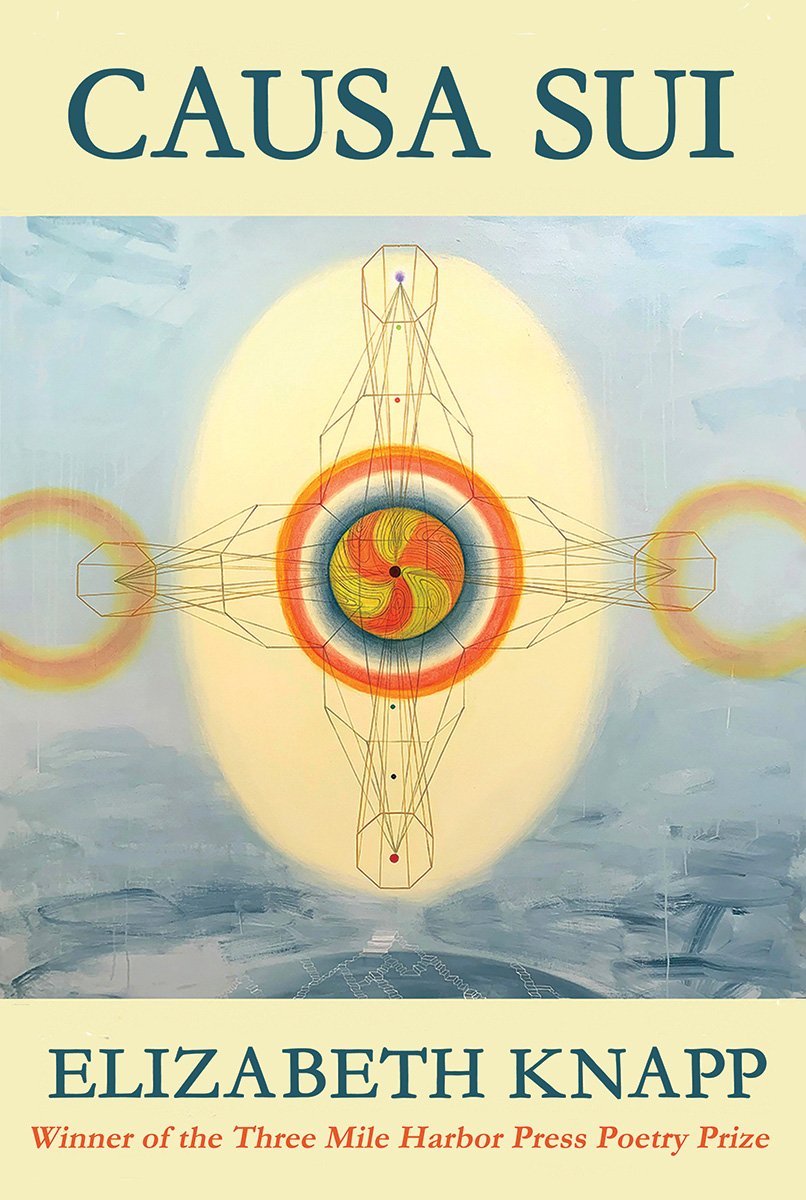
As I was writing the poems in Causa Sui, I worried that they would be too much like the poems in Requiem, that I was actually just writing the same book all over again. I think part of that was related to our collective déjà-vu—feeling like we were back in 2016, now only worse. Poets are obsessive creatures—all artists are to some extent—so of course certain subjects will recur throughout a poet’s work. For me, those subjects are what I see reflected in American life. If this new book is different, it’s in the way it confronts those subjects even more directly.
I noticed two forms you’re fond of: ars poetica and persona poems. Could you talk about why these seem especially compelling and how they open space for reinvention?
I think all poems are ars poeticas and persona poems, in the same way that all poems are elegies. Of course, some of my poems are explicitly in those modes, but I think my work as a whole is concerned with the idea of making—making poems, in particular—and with identity. Specifically, the poems in CausaSui are concerned with the idea of making art in a time of crisis. So the actors within that crisis emerge as the poems’ primary voices. For example, the speaker of the “‘We the People’: Found Poems from Project 2025” is the collective voice of the oppressor, although by the end, the speaker’s voice merges into the collective voice of the oppressed.
Sequences are incredibly challenging, and one that anchors Causa Sui is “‘We the People’: Found Poem from Project 2025” which is doubly difficult since it’s comprised of found poems. I know some writers work strictly within the bounds of a chosen text, while others are more flexible, generative, associative, and willing to let the found language seed new words and phrases. Could you talk about the process of selection and arrangement that guided you as you worked with found material?
I started “‘We the People’: Found Poems from Project 2025” as an erasure using Project 2025 as the source text but quickly discovered erasing 900+ pages of text to be overwhelming, so I wrote the series as found poems instead. Sometimes I would pick up words and phrases from a single page of the text, and sometimes I would start with a single word or phrase from the text and then build the poem around it. Once I finished a poem, I would check to make sure the words I used were also included in the text. I had a few rules: each poem had to be exactly nine brief lines (three tercets) and could not use punctuation or repeat words (except for articles, prepositions, and variations of “America”).
I really enjoyed “For My Student Who Claims That Where the Wild Things Are Is Not a Queer Text.” What advice do you have for students interested in exploring or teaching writing?
If you want to be a writer, read. Read everything you can get your hands on, especially in your genre, but also outside your genre. Then practice. Keep practicing. Keep reading. Keep writing. Think of it like athletic training or muscle memory. You strengthen that muscle memory every time you read and then practice your skills by writing.
Your poem “Change Management” (a wry commentary on filling out an annual review) speaks to the corporatization of education and the arts, as do several poems that you describe as “written in the manner of ChatGPT.” These felt a bit Audenesque to me, ironic, but also filled with the warning notes of lament. I’m curious about your process in writing these poems and if you find them restorative in any way?
The ChatGPT poems are erasures, so they’re playing on the concept of generative AI in poetry. I wouldn’t say I found writing those poems “restorative,” but I did find it satisfying. While ChatGPT and other LLMs are becoming increasingly—and alarmingly—adept at imitating a human voice, they still can’t write a good poem. ChatGPT will always use rhyme and meter, unless prohibited to in the prompt, but its free verse is no better. Whether formal or free verse, AI-generated poetry is generally painfully overwrought and clichéd, or else totally bizarre—in a hallucinatory sort of way. This is why I tell students that their own poems will invariably be better than anything AI can produce.
I know you’ve spent time abroad and that so many of your poems confront day-to-day political realities of contemporary life. Are there writers or artists who have inspired you or serve as models for your own aesthetic goals?
There are too many! The two contemporary poets whose work had the greatest influence on the poems in Causa Sui are Terrance Hayes and Nicole Sealey. Specifically, Hayes’s American Sonnets for My Past and Future Assassin and Sealey’s The Ferguson Report: An Erasure are two books I was actively reading and thinking about while writing my own.
Each of your books—and Causa Sui is no exception—pays witness to domestic life: the gritty realities of motherhood, the joys and challenges of married life. Those anniversary poems are so lyrically rich and vivid. Do you have any tips or tricks that guide you when you’re writing up close and personal about loved ones? Is this any easier since your spouse is a writer as well?
Love poems and poems about motherhood are by far the hardest for me to write. I find it so difficult to approach those subjects without lapsing into sentimentality and cliché. I want those poems to have a certain amount of humor and tenderness, but I always find myself treading carefully around them. Now every year, I get anxious in the weeks before my anniversary, because I know I have an anniversary poem to write. And if I don’t write it, I won’t have a gift. The fact that my spouse is also a writer only makes it worse—he knows a bad poem when he reads one!